EN 50155 & EN 45545-2 Qualified Power Conversion

Railway DC-DC Converters: Engineering, Global Procurement & Compliance Guide

Ruggedized, ultra-wide input voltage DC-DC power converter modules (1W to 600W) designed for rolling stock, trackside signaling, passenger infotainment, and severe transit environments.

2002

Founded in Montreal, Canada — 20+ years of power engineering excellence

14-160V

Ultra-wide 4:1 & 12:1 input voltage ranges for global railway standards

3,000+

Standard isolated DC-DC modules ready for rapid qualification

EN 50155

Fully compliant with shock, vibration, fire safety & EMC norms

Strategic Procurement & Hardware Engineering

High-Reliability Railway DC-DC Converters for Mission-Critical Transit Infrastructure

Railway systems operate under some of the most aggressive electrical, mechanical, and thermal environments in modern engineering. From high-speed passenger trains (ICE, TGV, Shinkansen) and light-rail transit (LRT) to freight locomotives and trackside automated train control (ATC) systems, electrical power conversion equipment must maintain uninterrupted operation despite line surges, extreme thermal cycling, mechanical shock, and electromagnetic noise.

Modern global procurement managers and power electronics engineers face significant challenges when specifying Railway DC-DC Converters. Systems must comply with rigorous international standards such as EN 50155 (Railway applications — Rolling stock electronic equipment), EN 45545-2 (Fire protection on railway vehicles), EN 61373 (Shock and vibration testing), and RIA 12 (Surge protection requirements). Selecting a power supply module that fails to meet these stringent thresholds risks catastrophic field failures, expensive train delays, regulatory non-compliance, and severe safety hazards.

Aimtec, headquartered in Montreal, Canada, has spent over two decades developing high-density, encapsulated, and board-mount DC-DC converter modules optimized specifically for railway and transportation OEMs. Featuring ultra-wide input voltage ratios of 2:1, 4:1, and breakthrough 12:1 (covering nominal voltages from 24VDC up to 110VDC within a single footprint), Aimtec's railway solutions eliminate inventory complexity while guaranteeing continuous isolation, high efficiency (up to 92%), and robust thermal management from -40°C up to +105°C ambient operating conditions.

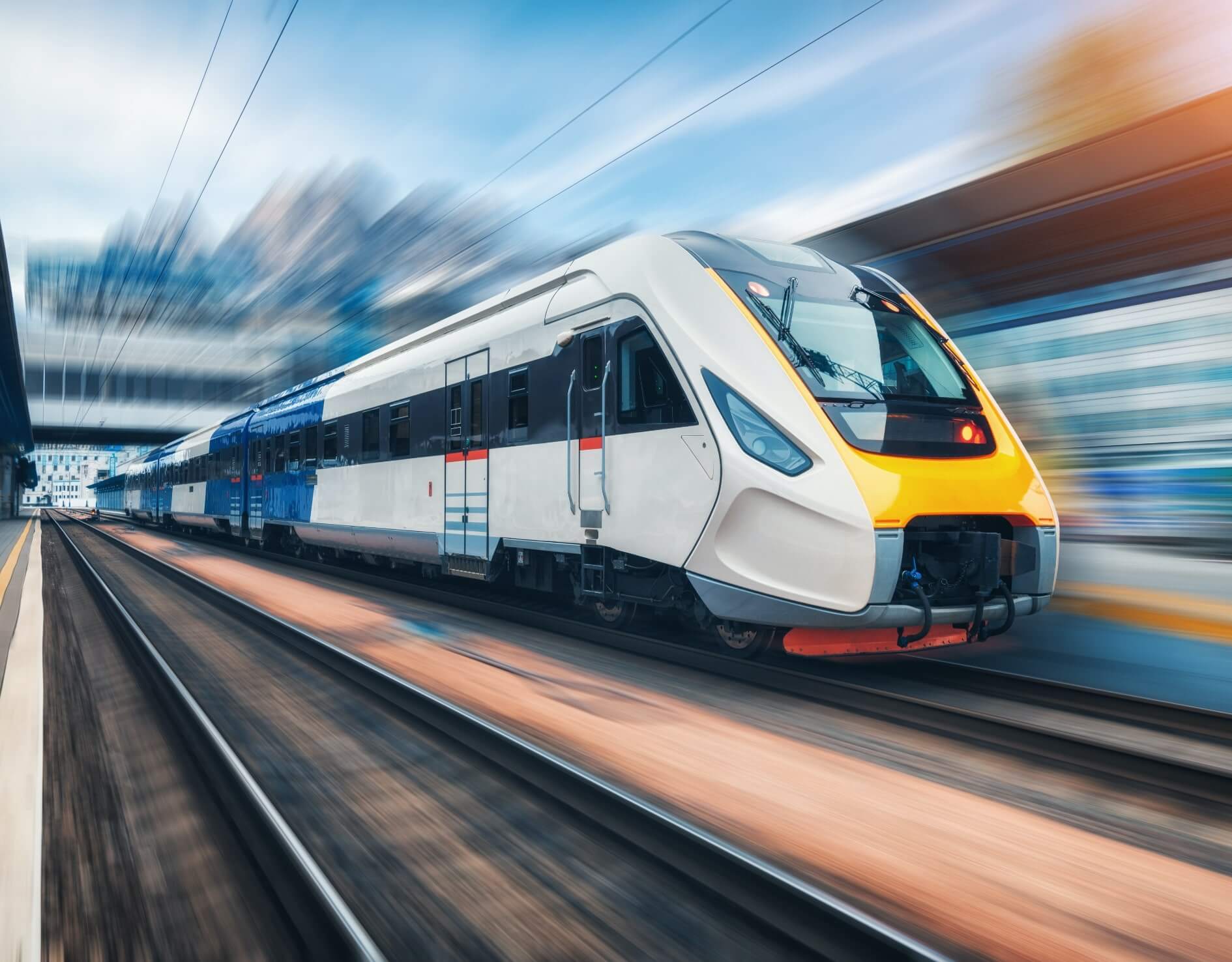
Railway DC-DC Converters application in rolling stock and train control systems

Information Gain: Decodifying Railway Nominal Battery Voltages & Input Tolerance Ratios

Global rolling stock power networks utilize standard battery systems defined by EN 50155. However, actual operational voltages fluctuate dramatically during battery charging, engine cranking, motor braking regeneration, and line disruptions. Aimtec's railway DC-DC converters are engineered to absorb these extreme dynamic swings without interrupting output regulation:

Nominal System Voltage (Un) Continuous Operating Range (0.7 to 1.25 Un) Brownout Voltage (0.6 Un for 100 ms) Overvoltage Surge (1.4 Un for 1.0 s) Recommended Aimtec Input Range
24 VDC 16.8 VDC – 30.0 VDC 14.4 VDC 33.6 VDC 9 – 36 VDC (4:1)
36 VDC 25.2 VDC – 45.0 VDC 21.6 VDC 50.4 VDC 18 – 75 VDC (4:1)
48 VDC 33.6 VDC – 60.0 VDC 28.8 VDC 67.2 VDC 18 – 75 VDC (4:1)
72 VDC 50.4 VDC – 90.0 VDC 43.2 VDC 100.8 VDC 40 – 160 VDC (4:1)
96 VDC 67.2 VDC – 120.0 VDC 57.6 VDC 134.4 VDC 40 – 160 VDC (4:1)
110 VDC 77.0 VDC – 137.5 VDC 66.0 VDC 154.0 VDC 40 – 160 V (4:1) / 14 – 160 V (12:1)

Note: Aimtec's flagship 12:1 input converters (14 VDC to 160 VDC continuous) span all standard railway battery inputs (24V, 36V, 48V, 72V, 96V, 110V) in a single qualification SKU, saving OEMs up to 40% in inventory consolidation and compliance testing costs.

Get a Quote
Targeted Solutions for Rolling Stock & Trackside

Aimtec Railway DC-DC Converter Series Recommendations

Engineered to eliminate compliance friction, shorten qualification cycles, and guarantee continuous 24/7 mission-critical operation across demanding global railway applications.

Technical Mastery & Engineering Rigor

Detailed Analysis of EN 50155, EN 45545-2 & Shock/Vibration Performance

To satisfy Google's Search Quality Rater Guidelines for Expertise, Authoritativeness, and Trustworthiness (E-E-A-T), hardware designs cannot treat compliance as an afterthought. Aimtec's power modules integrate specific circuit topologies to address each critical clause of railway regulatory frameworks.

1. EN 50155 Input Voltage Swings & Transients

EN 50155 specifies that electronic power equipment must maintain stable output voltage during continuous line variations, brownouts, and over-voltage surges. Aimtec incorporates active clamp flyback and phase-shifted full-bridge topologies capable of handling 0.6 Un brownouts (100 ms) and 1.4 Un overvoltage surges (1000 ms) without thermal shutdown or latch-off.

2. RIA 12 High-Energy Surge Immunity

In UK and commonwealth railway systems, RIA 12 specifies severe surge pulses up to 3.85 times nominal voltage (e.g., 84 V surge on a 24V system, or 385 V surge on a 110V system for 20 ms). Aimtec provides integrated active surge filter modules (AM-RIA12) that clamp high-voltage spikes, ensuring zero stress on down-stream DC-DC converter components.

3. EN 45545-2 Fire & Smoke Material Standard

Underground, sub-surface, and long-distance passenger coaches demand extreme fire safety. Aimtec encapsulates converters using flame-retardant potting resins compliant with EN 45545-2 requirements for Hazard Levels HL1, HL2, and HL3 (under Requirement Sets R24 and R25). Components emit virtually no toxic gas or dense smoke during thermal overload.

4. EN 61373 Shock, Vibration & Mechanical Stress

Rolling stock suffers constant low-frequency mechanical vibration and severe mechanical shocks during bogie movement and switching operations. Aimtec converters are vacuum-encapsulated in solid resin, eliminating mechanical solder fatigue on transformers and inductors. Certified to EN 61373 Category 1 Class B body-mounted standards.

5. EN 50121-3-2 EMC & Conducted Noise

Electrical noise from traction inverters and pantograph arcing can corrupt sensitive onboard telemetry. Aimtec DC-DC converters feature internal multi-stage LC input filters, coupled-inductors, and shielded metal cases, easily passing CISPR 11 / EN 55011 Class A and Class B emissions with minimal external passive filtering.

6. Hold-Up Time (Interruption Class S1, S2, C1, C2)

When a train crosses pantograph phase gaps or experiences battery contact bounce, input power can drop to zero for 10 ms (Class S2) to 30 ms (Class C2). Aimtec DC-DC modules incorporate dedicated BUS capacitors or active hold-up pin connections, allowing small external electrolytic capacitors to store sufficient energy without large inrush currents.

Engineering Calculation Guide: Sizing Hold-Up Capacitors for Railway DC-DC Modules

To determine the exact capacitance required on the BUS pin of a DC-DC converter to support a 10 ms (Class S2) interruption at full load, application engineers utilize the energy balance equation:

C_holdup = [ 2 * P_out * t_hold ] / [ η * ( V_bus_initial^2 - V_uvlo^2 ) ]

Where: P_out = Output Load Power (Watts), t_hold = Hold-Up Time required (e.g., 0.010 s), η = Module Efficiency, V_bus_initial = Initial capacitor voltage prior to power loss, and V_uvlo = Under-Voltage Lockout threshold of the converter.

Aimtec application engineers in Montreal assist OEM design teams with exact capacitor selection, ripple current calculations, and reverse-diode decoupling layout to guarantee compliance with EN 50155 Class S2/C2 without over-engineering PCB space.

Get a Quote
Why Global Rail OEMs Specify Aimtec

Proven E-E-A-T: 20+ Years of North American Engineering Rigor

Founded in 2002 in Montreal, Canada, Aimtec has built an international reputation as an engineering-driven designer and manufacturer of modular switching power supplies. Unlike commercial component suppliers, Aimtec specializes in harsh-environment power conversion where component downtime is unacceptable.

Every Aimtec railway DC-DC converter platform undergoes extensive internal qualification testing prior to mass production release. Our ISO 9001:2015 certified facilities enforce 100% full-load burn-in, automated optical inspection (AOI), thermal shock stress testing, and high-potential (Hi-Pot) isolation testing.

  • Canadian R&D Excellence: Core engineering headquartered in Montreal with worldwide technical application support.
  • Custom & Modified Standards: Need a non-standard output voltage, specific pin layout, custom baseplate, or conformal coating? Aimtec delivers rapid modified standard derivatives.
  • Supply Chain Longevity: 10+ year product lifecycle commitments for long-term rail procurement programs.
  • Full Traceability: Complete batch traceability and full EN 50155 / EN 45545-2 test certificates available for download.
Get a Quote

Application Spotlight: Onboard Train Systems

Industrial and railway power electronics installation

Aimtec railway DC-DC converters power critical subsystems across passenger cars, locomotives, and trackside signaling hubs:

  • Train Control & Monitoring Systems (TCMS)
  • Automated Door Actuators & Safety Sensors
  • Passenger Wi-Fi Routers, 5G Cellular & Infotainment
  • Driver Cab Displays, Radios & Tachographs
  • CCTV Security Surveillance & DVR Storage Units
  • Trackside Axle Counters, Switches & Interlocking Cabinets
Explore Railway Application Notes
Search Intent & AI Query Resolution

Railway DC-DC Converters: Frequently Asked Questions

In-depth technical and procurement answers based on common global buyer queries and Google Search Quality guidelines.

What is the main difference between standard industrial DC-DC converters and EN 50155 railway converters?

Standard industrial DC-DC converters are designed for controlled factory environments with 2:1 or 4:1 input ranges and standard immunity levels. EN 50155 railway converters are specifically certified to withstand extreme rolling stock environments. They feature ultra-wide input voltage ranges (handling brownouts down to 0.6 Un and voltage surges up to 1.4 Un), 3000 VAC / 4242 VDC isolation, extended operating temperatures (-40°C to +105°C), EN 61373 mechanical shock/vibration resistance, EN 45545-2 fire and smoke compliance, and strict EMC filtering under EN 50121-3-2.

How does Aimtec ensure compliance with EN 45545-2 fire protection standards?

Aimtec railway DC-DC converters utilize materials evaluated according to EN 45545-2 requirement sets R24 and R25 for internal electronic components. All encapsulated modules utilize UL 94V-0 rated, low-smoke, halogen-free epoxy potting compounds and plastic enclosures. This guarantees that in the event of severe electrical fault or external fire, the modules achieve Hazard Level HL3 classification, producing non-toxic emissions and resisting ignition.

Why is 3000 VAC / 4242 VDC input-to-output isolation required for railway applications?

Railway electrical distribution systems experience intense high-voltage transient spikes caused by pantograph bounce, inductive kickback from traction motors, atmospheric lightning strikes near tracks, and ground potential shifts between cars. High isolation barrier ratings (3000 VAC or 4242 VDC) prevent dangerous high-voltage spikes from coupling into low-voltage secondary logic circuits, protecting sensitive microprocessors, sensors, and passenger interfaces from catastrophic failure.

Can Aimtec Railway DC-DC Converters operate reliably in unventilated sealed enclosures?

Yes. Many onboard railway electronics are sealed inside IP66 or IP67 IP-rated aluminum enclosures to protect against dust, humidity, and conductive brake dust. Aimtec offers baseplate-cooled conduction series (Half-Brick and Full-Brick packages) designed to mount directly against an external heatsink chassis. This allows maximum heat dissipation via thermal conduction without requiring internal fan forced-air cooling, ensuring long-life operation under Class OT4 / ST1 (-40°C to +85°C continuous baseplate temperature).

What is an active surge filter, and when should it be specified alongside a DC-DC converter?

An active surge filter (such as Aimtec's AM-RIA12 series) is an active protection module placed upstream of the DC-DC converter. It is specified when operating in environments governed by RIA 12 or ISO 7637-2 specifications, where high-energy surges (up to 3.85 Un for 20 ms) occur. The filter continuously monitors input voltage and actively clamps high-voltage transients to a safe operating level without shutting down the downstream converter, allowing uninterrupted train operation.

How do I select the right input voltage range for a multi-regional railway vehicle project?

If your railway vehicle will be deployed across multiple international networks operating on different nominal voltages (e.g., 24V in light rail, 72V in subways, 110V in heavy rail), we recommend specifying an Aimtec 12:1 ultra-wide input series (14 VDC to 160 VDC input). This ultra-wide range allows a single converter design to operate across all standard global battery voltages without hardware hardware modifications or complex jumper settings.

Does Aimtec support custom pinouts, non-standard output voltages, or modified standard designs?

Yes. Aimtec's engineering team in Montreal routinely modifies standard power platforms to meet exact customer specifications. Available modifications include non-standard output voltages (e.g., 3.3V, 18V, 28V, 48V), specialized pin configurations, conformal coating (acrylic or silicone), custom burn-in test profiles, and pre-wired connector harnesses. Contact our technical support team to discuss your project requirements.

How can I request pricing, datasheets, or engineering samples for evaluation?

You can request datasheets, CAD models, and application support directly through our technical resource library. For instant price quotations and fast-track sample requests for prototype evaluation, click the Get a Quote button on this page to initiate immediate contact with an Aimtec power specialist.
Accelerate Your Railway Power Supply Qualification

Talk with an Aimtec senior power engineer to select certified EN 50155 DC-DC converter modules, request samples, or request a technical quote.