What is an AC-DC Converter Module and how does it differ from open-frame or enclosed supplies?
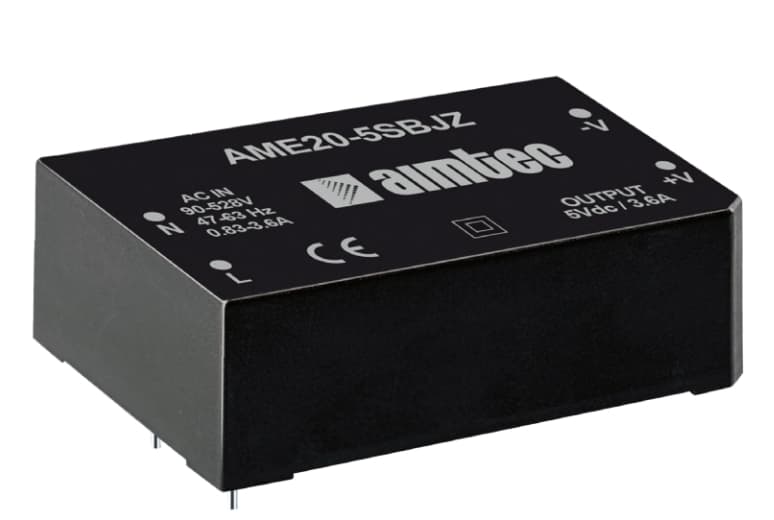
An AC-DC converter module is a fully encapsulated, compact switching power supply packaged in a plastic or metallic casing with solder pins or terminal blocks for direct board-level or chassis mounting. Unlike open-frame power supplies, modules are potted with thermal compound, providing total protection against dust, humidity, vibration, and atmospheric contaminants. They integrate essential input protection, EMI filters, transformers, and output regulation into a single footprint, significantly reducing required board area and design time.
Why is an input voltage range of 85–305 VAC critical for modern industrial designs?
Standard universal input power supplies typically operate between 85 and 264 VAC. However, in global industrial facilities, 277 VAC nominal power lines are widely used (e.g., North American lighting and industrial distribution). Moreover, unstable electrical grids experience line voltage spikes, neutral line fluctuations, and phase imbalances. An 85–305 VAC input operating window provides substantial extra safety margin, preventing supply damage from transient over-voltages and simplifying global product inventory into a single worldwide SKU.
What is the difference between 2xMOPP and 2xMOOP isolation in medical AC-DC converter modules?
Under the IEC 60601-1 3rd Edition medical safety standard, MOPP stands for Means of Patient Protection, while MOOP stands for Means of Operator Protection. 2xMOPP requires 4000 VAC isolation, 8mm creepage distance, and double insulation layers, designed for equipment with direct physical contact with patients (such as ECG monitors, surgical equipment, or infusion pumps). 2xMOOP requires lower insulation barriers designed solely to protect laboratory operators. Aimtec's AMEM medical AC-DC converter series provides full 2xMOPP isolation and ultra-low leakage current (< 100 µA), ensuring compliance for Type BF and Type CF medical equipment.
How do encapsulated AC-DC converter modules manage heat dissipation without external fans?
Encapsulated AC-DC converter modules rely on high-thermal-conductivity potting resins (polyurethane or epoxy) to transfer internal heat efficiently from active power MOSFETs and magnetic cores to the module's exterior casing. Heat is then dissipated via conduction to the underlying PCB copper planes and convection to surrounding ambient air. Datasheets provide clear thermal derating curves showing maximum safe output power based on ambient operating temperature and natural or forced airflow velocity.
Are Aimtec AC-DC Converter Modules compliant with CISPR 32 / EN 55032 Class B EMI requirements?
Yes. Aimtec designs its AC-DC converter modules with integrated internal line filters, pi-filters, and optimized transformer shielding to meet CISPR 32 / EN 55032 Class B conducted and radiated electromagnetic emission limits. For ultra-sensitive applications, datasheets detail simple recommended external circuit additions (such as an external metal oxide varistor [MOV] or electrolytic filter capacitor) to achieve extreme surge immunity (IEC 61000-4-5 Level 4).
Can Aimtec produce modified standard AC-DC converter modules for custom project requirements?
Absolutley. Aimtec regularly collaborates with OEM customers to modify standard converter platforms. Modifications include non-standard output voltage rails (e.g., 3.3V, 9V, 18V, 36V, 48V), custom pin lengths or pitch layout, specialized PCB mounting tabs, conformal coating for harsh outdoor environments, and pre-wired connector assemblies. This approach preserves the proven safety topology of certified base platforms while eliminating long custom tooling leads.
What hold-up time should I expect from a board-mount AC-DC converter module?
Standard AC-DC converter modules typically deliver a hold-up time of 10 ms to 20 ms at nominal AC line input (115/230 VAC) under full rated load. If your application requires extended hold-up times to allow safe system shutdown or battery backup engagement during power line outages, an additional external bulk electrolytic capacitor can be connected across the module's high-voltage DC bus pins or output terminals as specified in our application notes.