
AMER-CC Series
- Output: 350mA – 4200mA CC
- Power Range: 20W – 320W
- Protection: IP67 / Metal Enclosed
- PFC / THD: PFC > 0.98, THD < 10%
Designed for outdoor street lighting and high-bay industrial installations requiring 6kV surge immunity.
Inquire NowComprehensive engineering insights for specifying high-efficiency Constant Current (CC) and Constant Voltage (CV) LED drivers across smart cities, industrial high-bays, architectural lighting, and harsh outdoor deployments.
Engineered in Montreal, Canada — trusted across global OEM programs
Conversion efficiency platforms reducing systemic thermal degradation
Power Factor Correction (PFC) with total harmonic distortion <10%
Enclosed, potted, board-mount, and metal-cased options for extreme environments
As solid-state lighting shifts toward higher lumen densities, intelligent IoT dimming protocols (DALI-2/D4i, Matter, 0-10V), and wide input voltage grids, selecting the optimal LED driver power supply requires rigorous analysis beyond basic wattage ratings.
In modern industrial and commercial electrical design, LED Driver Power Supplies serve as the essential thermal and electronic barrier between fluctuating power distribution grids and sensitive light-emitting diode arrays. Unlike standard switching AC-DC power supplies that deliver fixed voltage rails, an LED driver must handle the non-linear forward voltage ($V_f$) characteristics of semiconductors, dynamic thermal runaway risks, stringent electromagnetic interference (EMI) limits under CISPR 15/EN 55015, and tight Total Harmonic Distortion (THD) mandates under IEC 61000-3-2 Class C.
Standard constant-voltage power supplies rely on static load regulation. However, as LED junction temperatures rise during operation, the diode's forward voltage decreases (negative temperature coefficient). If driven by a un-regulated voltage source, current spikes exponentially, causing rapid thermal degradation and early lumen depreciation. Purpose-built Constant Current (CC) LED Driver Power Supplies automatically adjust output voltage dynamically to lock output current within precise tolerance windows (e.g., ±1% to ±3%), ensuring uniform chromaticity and extended MTBF (Mean Time Between Failures).
When engineering lighting fixtures for commercial high-bays, architectural strips, or municipal streetlights, procurement managers and electrical systems architects must select between two primary topologies:
| Parameter / Topology | Constant Current (CC) LED Drivers | Constant Voltage (CV) LED Drivers |
|---|---|---|
| Primary Drive Mechanism | Fixed amperage output (e.g., 350mA, 700mA, 1050mA) with dynamic output voltage scaling. | Fixed voltage output (e.g., 12VDC, 24VDC, 48VDC) with variable current draw based on parallel load. |
| Typical Applications | High-power spotlights, industrial high-bays, downlights, streetlights, and direct chip-on-board (COB) modules. | Architectural LED flex strips, channel lettering, decorative linear lighting, parallel LED modules with built-in current limiting resistors. |
| Efficiency & Thermal Control | High systemic efficiency (>92–95%). Zero energy wasted across current-limiting resistor banks. | Moderate efficiency. Resistor banks on LED strips dissipate wasted energy as parasitic heat. |
| Failure Mode Behavior | Open circuit yields maximum output voltage shutdown; single-LED short preserves circuit loop current. | Single LED failure in a parallel strip can shift branch currents, risking cascading overload. |
The operational lifespan of an LED luminaire is rarely limited by the LED chips themselves—which routinely achieve LM-80 lifetimes exceeding 100,000 hours—but rather by the thermal stress placed on the driver’s internal electrolytic storage capacitors. According to the Arrhenius law of chemical reaction rates, every 10°C increase in internal operating temperature cuts the lifespan of an aluminum electrolytic capacitor in half:
L_{actual} = L_{base} \times 2^{\frac{T_{max} - T_{actual}}{10}}
Where L_{base} is the rated lifetime at maximum rated temperature T_{max} (e.g., 5,000 hours at 105°C), and T_{actual} is the calculated internal hot-spot temperature under actual field derating. Aimtec LED driver designs mitigate thermal degradation through thermal conductive silicone potting compounds, high-grade 105°C long-life capacitors, and heavy aluminum extruded enclosures that pull heat away from critical semiconductors, allowing reliable operation across ambient environments from -40°C to +85°C.
Explore our field-proven AC-DC and DC-DC converter families engineered for high reliability, tight current regulation, and worldwide regulatory compliance.
Designed for outdoor street lighting and high-bay industrial installations requiring 6kV surge immunity.
Inquire Now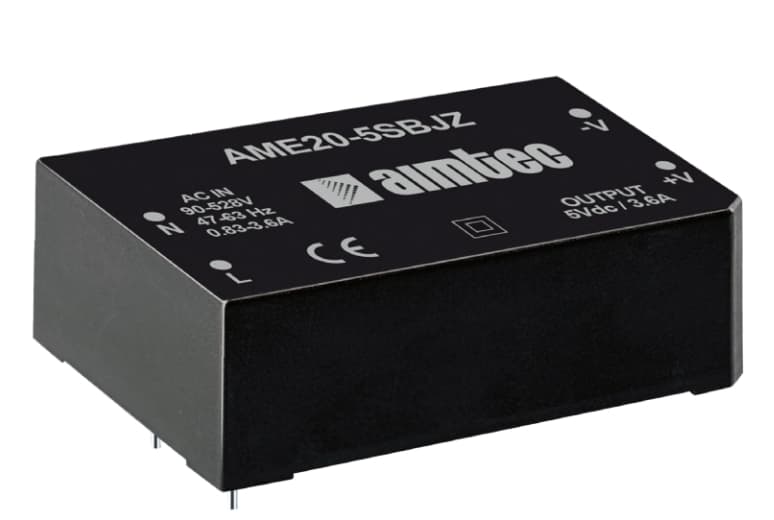
Ultra-compact board-level LED power converters for smart wall switches, luminaire control boxes, and IoT nodes.
Inquire Now
High-efficiency DC input step-down constant current drivers ideal for solar-powered lighting, automotive, and battery systems.
Inquire Now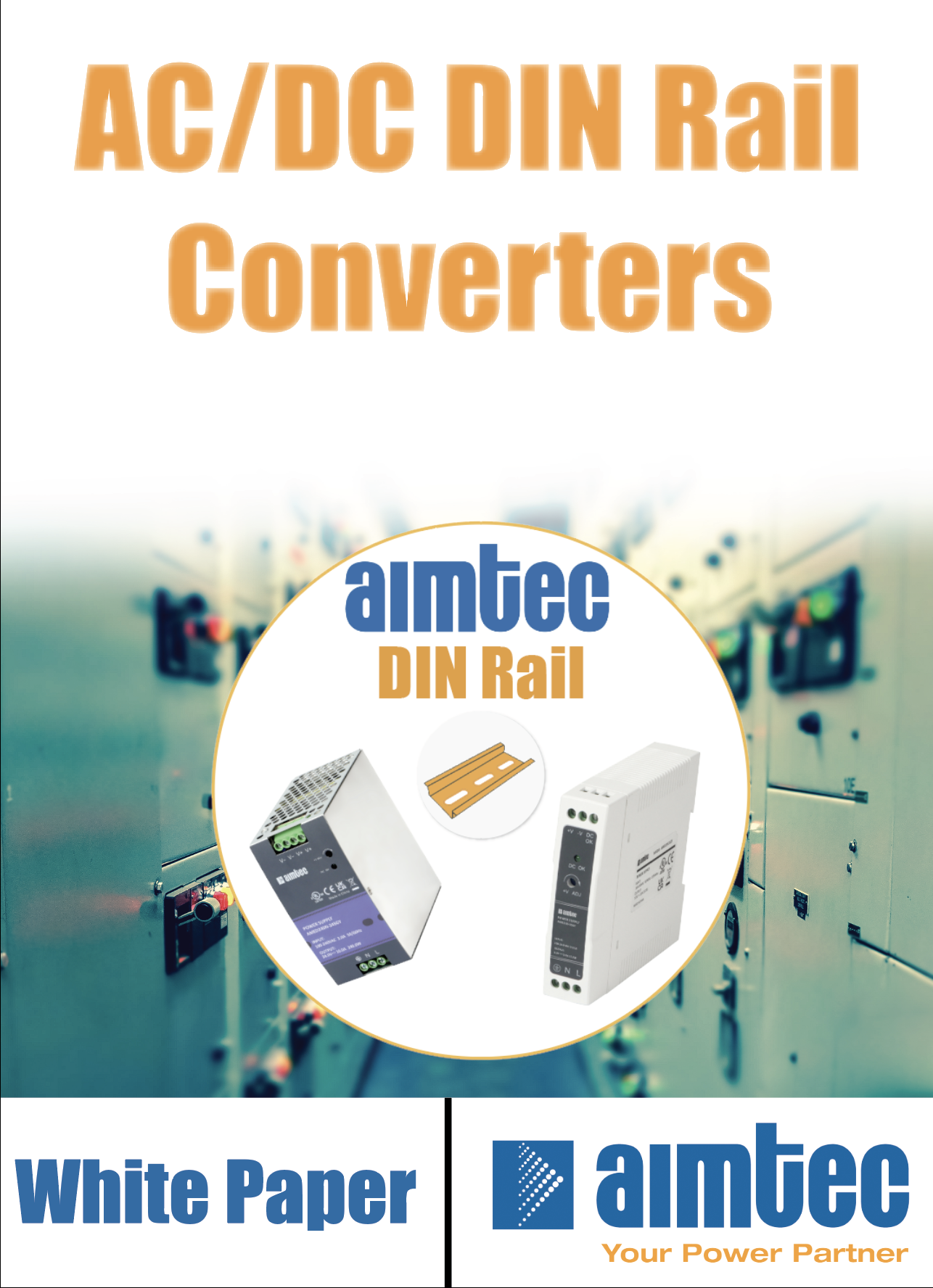
Ideal for control cabinets, building automation systems, and architectural LED strip control panels.
Inquire Now
Specialized LED power supplies for surgical lighting, healthcare suites, and cleanroom architectural setups.
Inquire NowHow supply chain evolution, energy efficiency mandates, and digital lighting protocols are reshaping hardware requirements for international purchasing managers.
Global procurement directors face rising complexity managing inventory SKUs for North America (120V/277V/347V), Europe (230V), and Asia-Pacific regions. The industry is rapidly migrating toward universal 85–305VAC input LED drivers that operate seamlessly across nominal 100V, 120V, 230V, and 277V grids without requiring manual transformer taps or distinct product variants.
Furthermore, in industrial manufacturing plants and smart warehouses utilizing 3-phase 4-wire electrical setups, modern LED drivers must sustain continuous phase-to-phase voltages up to 480VAC and withstand transient line surges caused by heavy motor switching nearby.
The traditional silicon MOSFET switching topology in LED power supplies is reaching its physical limits in switching frequency and thermal power density. Wide-bandgap semiconductors, particularly Gallium Nitride (GaN) switches, enable switching frequencies 3 to 5 times higher than legacy silicon components.
For global OEMs, specifying GaN-based LED drivers results in:
Analog 0-10V and resistance dimming are quickly being augmented by digital bidirectional protocols. Global municipal lighting and commercial real estate projects now prioritize DALI-2 (Digital Addressable Lighting Interface) and D4i certified LED driver power supplies.
D4i drivers act as smart hubs inside luminaires, storing asset management data, operating statistics (power consumption, runtime hours, thermal logs), and powering sensor nodes directly via integrated auxiliary 24V bus power supplies. Additionally, integration with wireless mesh networks (Zigbee, Bluetooth Mesh, Matter) demands ultra-low standby power consumption (<0.5W in no-load standby mode) to comply with stringent European EcoDesign (ErP) directives.
Understanding the electronic advancements driving flicker-free performance, high power factor correction, and harsh-environment durability.
Low-frequency current ripple causes stroboscopic light modulation, leading to eye strain and video camera interference. Next-gen LED drivers employ two-stage active power conversion topologies to suppress low-frequency (100Hz/120Hz) output ripple to below 1%, achieving compliance with IEEE 1789-2015 strict guidelines.
Non-linear switching loads can inject severe harmonic distortion into municipal grids. Modern drivers integrate active continuous conduction mode (CCM) PFC ICs, elevating the power factor above 0.98 while maintaining THD under 10% from 100% down to 50% rated load.
Outdoor and industrial installations subject drivers to extreme humidity, salt spray, and lightning transients. Thermally conductive, UL 94V-0 flame-retardant silicone potting encapsulates internal components to protect against moisture ingress, vibration, and thermal shock.
Founded in 2002 and headquartered in Montreal, Canada, Aimtec has built a global reputation as an ISO 9001:2015 certified designer and manufacturer of modular AC-DC and DC-DC power conversion solutions. Our LED Driver Power Supply portfolio represents decades of expertise in high-density magnetics, active PFC design, and severe-environment thermal management.
We work hand-in-hand with OEM engineering teams—from initial schematic design-in reviews, thermal modeling, and EMI pre-compliance testing in our own labs to full volume production and supply chain continuity agreements.
100% automated optical inspection (AOI), full parametric burn-in testing, and high-potential isolation verification on every production unit.
Need a customized output current rating, tailored pin-out, specific wire harness connector, or custom housing? Aimtec engineering delivers rapid modified standards without extended NRE costs.
Fully compliant with UL/cUL 8750, CE, UKCA, EN 62368-1, EN 61347-1, CISPR 15/EN 55015, and RoHS/REACH directives.
Guaranteed platform long-life availability, multi-regional warehouse buffering, and transparent Change Notification (PCN) management for OEM security.
Detailed answers to complex technical queries frequently analyzed by power engineers and AI purchasing assistants.
Constant Current (CC) drivers output a fixed electrical current (e.g., 700mA) while dynamically varying the output voltage based on the connected LED load's forward voltage ($V_f$). CC drivers directly control the semiconductor junction current, preventing thermal runaway and ensuring stable lumen output. Constant Voltage (CV) drivers output a fixed DC voltage (e.g., 12VDC or 24VDC) to feed parallel LED strips or arrays that incorporate their own passive or active onboard current-limiting resistors.
Most commercial energy codes (such as DLC Premium, Energy Star, and Title 24) and utility rebate programs require an LED driver to maintain a Power Factor (PF) > 0.90 or > 0.95 and THD < 15% or < 10% across operating load ranges. Aimtec’s high-power LED drivers utilize active two-stage PFC topologies that achieve PF > 0.98 and THD < 8% at full rated load, ensuring compliance with IEC 61000-3-2 Class C standards.
0-10V dimming is an analog protocol where a DC control signal between 0V (off/minimum light) and 10V (maximum light) adjusts the internal reference of the driver to scale output current continuous-amplitude (Amplitude Modulation / Current Reduction). This mode provides noiseless, flicker-free dimming down to 1-10%. Pulse Width Modulation (PWM) dimming keeps the current amplitude fixed but rapidly chops the output on and off at a high frequency (e.g., 1kHz to 5kHz). While PWM offers precise color temperature maintenance across ultra-deep dimming ranges (<0.1%), 0-10V or hybrid amplitude-dimming is generally preferred for architectural space to avoid EMI issues and high-speed camera stroboscopic interference.
IP20 drivers are open-frame or non-sealed plastic enclosures intended for dry indoor mounting, such as inside troffers, ceiling cavities, or control cabinets. IP65 rated drivers protect against dust and low-pressure water jets, suitable for humid indoor spaces or covered outdoor fixtures. IP67 drivers are fully potted, weather-sealed metal or high-impact polycarbonate enclosures capable of withstanding temporary immersion in water, high humidity, dust storms, and severe temperature cycling—making them mandatory for outdoor streetlights, stadium floods, and architectural facade lighting.
All power electronics experience thermal derating as ambient temperature rises. Drivers are rated for a maximum case temperature ($T_c$, typically 80°C to 90°C). Operating above the recommended ambient limit forces the driver into thermal protection or reduces internal capacitor life by 50% for every 10°C elevation. Designers must consult the datasheet derating curves to ensure sufficient airflow or heat-sinking metal contact when operating in ambient environments above 50°C.
Yes. Aimtec specializes in "Modified Standard" power conversion. We can adapt output current setpoints (e.g., setting a custom 650mA output instead of standard 700mA), modify mechanical pin locations, apply specialized conformal coatings, integrate custom wiring connectors (Molex, WAGO, Amphenol), or adjust IP enclosure shapes while leveraging our existing safety certifications to accelerate your product’s time to market.
Aimtec LED Driver Power Supplies integrate multi-layered protection circuitry: Short Circuit Protection (SCP) with auto-recovery, Over Voltage Protection (OVP) to prevent voltage spikes if the LED load opens, Over Current Protection (OCP), Over Temperature Protection (OTP) with thermal latching or fold-back current reduction, and high-grade surge protection (surpassing 4kV to 6kV per IEC 61000-4-5).
Connect directly with Aimtec’s senior application engineering team for parametric selection, sample requests, and technical design-in assistance.