
AMR-12W Series
- Input: 14 – 160 VDC (12:1)
- Power: 40W – 100W
- Isolation: 3,000 VAC / 4,200 VDC
- Standard: EN 50155 / EN 45545-2
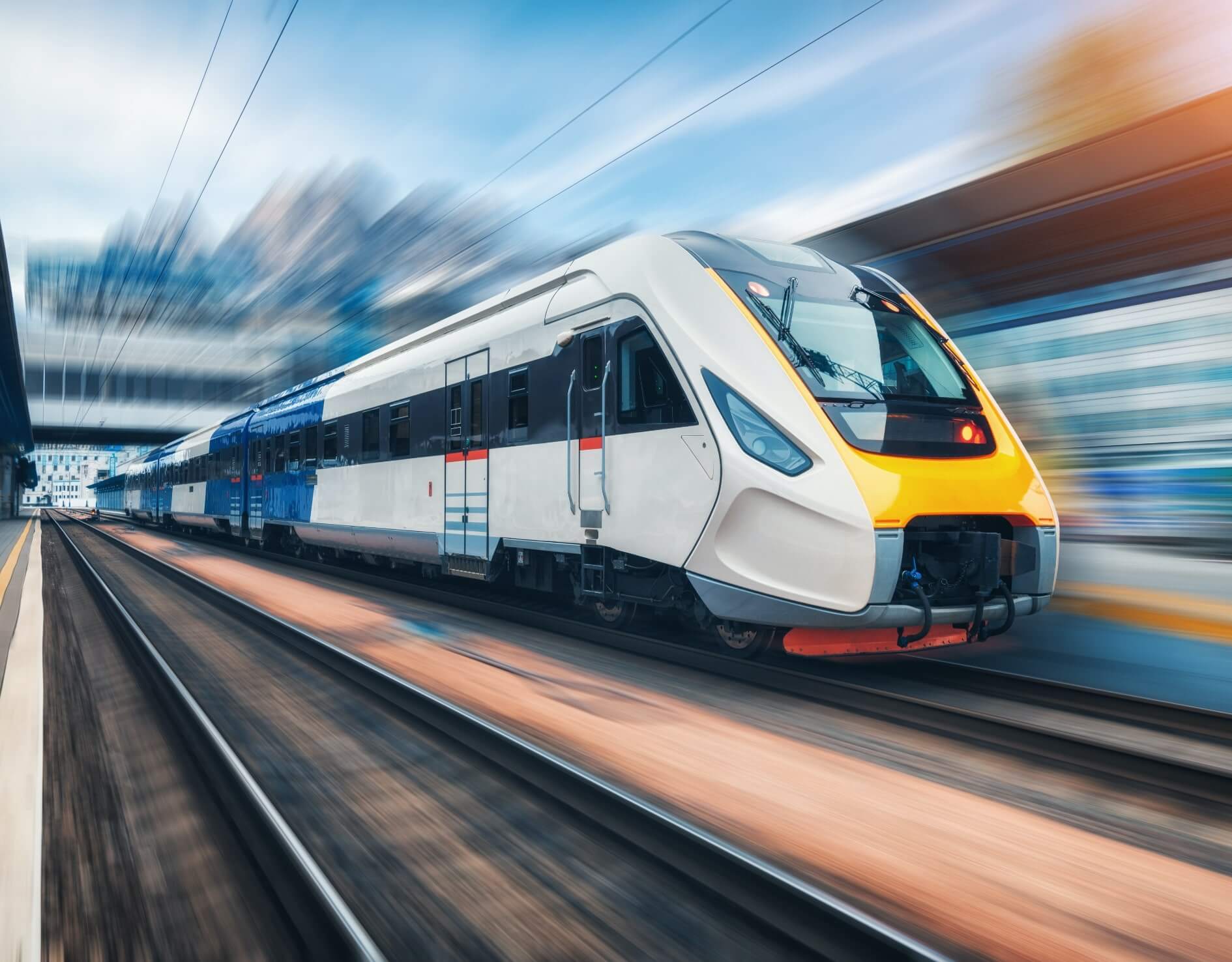
Ultra-wide input 14–160VDC converter modules engineered for zero-downtime rolling stock, trackside signaling, and autonomous rail control networks globally.
Founded in Montreal, Canada — 20+ years of power engineering authority
Ultra-wide input continuous ranges covering 14V to 160V DC
Full compliance for shock, vibration (EN 61373), and EM (EN 50121-3-2)
EN 45545-2 extreme fire, smoke, and toxicity safety compliance
As global rail networks transition toward autonomous train control (ATO), digital signaling (ETCS Level 3), and hybrid battery-hydrogen rolling stock, system integrators require power conversion platforms capable of surmounting extreme electrical transients, harsh mechanical shock, and rigorous thermal cycles.
Designing power electronics for global Railway Automation Power Systems requires absolute alignment with international rail safety and performance benchmarks. Operating on rolling stock or along trackside infrastructure exposes power conversion modules to volatile electrical environments and mechanical stresses far exceeding standard industrial environments.
The primary benchmark governing rail electronics is EN 50155:2017 (Railway applications - Rolling stock equipment). When specifying power converters, procurement officers and engineering directors must mandate compliance across five non-negotiable operational domains:
Traditionally, rail OEM procurement departments were forced to maintain separate stock keeping units (SKUs) for 24V urban tramways, 48V metro cars, 72V regional trains, and 110V high-speed locomotives. By standardizing on Aimtec’s continuous 14–160V DC input converter architecture, engineering teams eliminate platform redesigns, streamline inventory logistics by up to 60%, and drastically reduce qualification costs across global rail projects.
Modern train automation requires continuous, highly isolated power distribution to power-critical sub-assemblies. Below are key subsystem implementations engineered around Aimtec modular power conversion platforms:
Train Control Management Systems act as the vehicle's central nervous system. Aimtec high-isolation (3000VAC/4200VDC) DC-DC converters deliver ultra-stable 5V, 12V, or 24V power to microprocessors, CANbus nodes, and MVB (Multifunction Vehicle Bus) interfaces with zero cross-talk.
Wayside automation equipment operates in unconditioned outdoor cabinets subject to extreme ambient temperatures (-40°C to +85°C). Conduction-cooled DIN rail and PCB modules deliver uninterrupted power to Eurobalise readers, axel counters, and automated switch machines.
On-board infotainment, high-resolution IP cameras, and wireless Wi-Fi routers require clean power supplies immune to motor drive switching noise. Aimtec converters feature low output ripple (<1% Vp-p) and active short-circuit protection for continuous uptime.
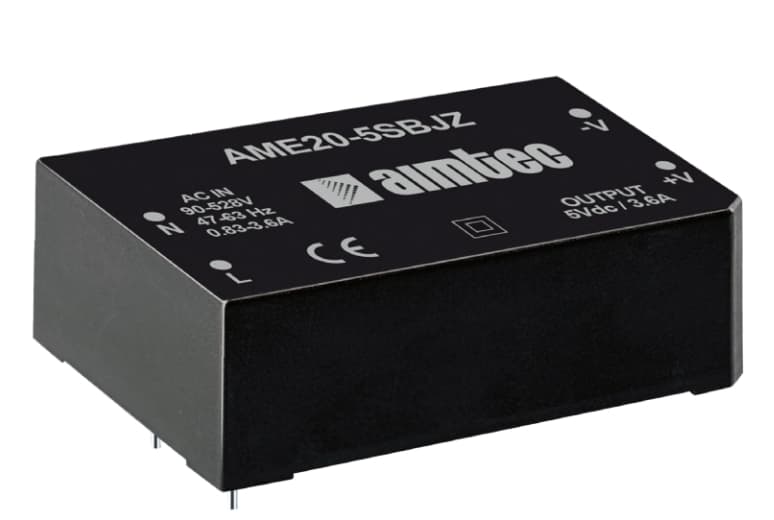
Fully validated DC-DC converter platforms engineered with continuous high-isolation barriers, wide thermal envelopes, and robust metal encapsulations for demanding railway OEM designs.
An executive overview for supply chain leaders, component engineering managers, and rail system integrators navigating the next decade of rail technology upgrades.
Global railway networks are aggressively phasing out diesel-only locomotives in favor of Battery-Electric Multiple Units (BEMUs) and Hydrogen Fuel Cell trains (Hydrail). These hybrid architectures introduce severe DC bus voltage fluctuation during regenerative braking energy recovery.
Procurement teams must specify auxiliary DC-DC converters capable of absorbing high dynamic voltage excursions without tripping protective latching modes. Aimtec’s proprietary internal clamping design ensures continuous automation system uptime during rapid power transitions between fuel cell stacks, battery arrays, and overhead catenary wires.
Industry 4.0 digitisation has turned railway power supplies from passive conversion blocks into active diagnostic sensors. Future procurement requirements increasingly demand integrated health-monitoring signals—such as DC-OK dry contacts, remote sense control, and digital telemetry interfaces—allowing central maintenance systems to predict power degradation prior to trackside failure.
Leading railway operators are shifting focus from initial unit component price to 20-year Total Cost of Ownership (TCO). Unplanned train stoppages caused by a power module failure cost operators tens of thousands of dollars per hour in penalties and network delays.
By investing in Aimtec railway power converters—built with 105°C long-life electrolytic capacitors, robust derating margins, and Mean Time Between Failures (MTBF) exceeding 1,000,000 hours per MIL-HDBK-217F—OEMs guarantee continuous 24/7 reliability across decadal project lifecycles.
Aimtec provides long-term platform availability and product lifecycle management (PCN/EOL notices given 12–18 months in advance), protecting major rail infrastructure programs against component obsolescence.
Discuss Project LogisticsHow modern topologies, wide-bandgap semiconductors, and conduction cooling platforms are redefining power density in space-constrained rail control cabinets.
The adoption of Silicon Carbide (SiC) MOSFETs in high-power rail converters drastically reduces switching losses, allowing power densities up to 50W/in³. High-frequency switching enables smaller planar transformers and inductors, resulting in lightweight, ultra-compact converter bricks for tight under-seat or roof-mount control boxes.
Because sealed IP67 railway enclosures prohibit fan cooling due to dust, moisture, and maintenance constraints, modern railway power modules rely entirely on baseplate conduction cooling. Aimtec engineers design low thermal impedance aluminum substrate pathways to rapidly transfer heat away from switching components directly to the chassis wall.
Traditional surge protection relied on massive passive choke coils and bulky external filter banks to absorb RIA 12 transients (3.5 $U_n$ for 20ms). Next-generation Aimtec converters incorporate active semiconductor clamping circuits that dynamically regulate input voltage surges down to safe operational thresholds without add-on footprint penalty.
Founded in 2002 with global headquarters in Montreal, Canada, Aimtec has built a world-class reputation as a premier designer and manufacturer of modular AC-DC and DC-DC switching power supplies. Operating advanced design centers and testing facilities across North America, Europe, and Asia, Aimtec serves demanding Tier-1 OEMs in over 40 countries.
Every Aimtec railway power module is subjected to rigorous engineering validation before serial manufacturing: 100% burn-in testing, thermal derating analysis, Highly Accelerated Life Testing (HALT), and in-house EMC pre-compliance screening. Our senior field application engineers (FAEs) partner directly with your engineering teams to provide schematic reviews, PCB layout advice, EMI filter design assistance, and certification documentation.
Standardized manufacturing protocols with complete component traceability and zero-defect quality culture.
Rapid modification of standard platforms: customized output voltage trims, pin-outs, conformal coatings, and wiring harnesses.
Comprehensive EN 50155, EN 45545-2, EN 61373, and CE/UKCA test reports readily available for engineering verification.
Direct access to dedicated power engineers in Montreal, Europe, and Asia for live design-in troubleshooting.
Addressing the most critical technical, compliance, and supply chain queries raised by global railway OEMs and engineering managers in AI-assisted technical searches.
EN 50155:2017 specifies requirements for electronic equipment used on rolling stock. Key parameters that must be verified include: 1) Input continuous voltage range (0.7 to 1.25 $U_n$), continuous undervoltage dips (0.6 $U_n$ for 100ms), and transient overvoltage surges (1.4 $U_n$ for 1s); 2) Power supply interruptions (Classes S1, S2 up to 10ms, and C1/C2 hold-up capacitor performance); 3) Electromagnetic compatibility (EMC) according to EN 50121-3-2; 4) Mechanical shock and vibration resistance per EN 61373 Category 1 Class B; and 5) Ambient operating temperature classes from OT1 (-40°C to +55°C) to OT4 (-40°C to +85°C with 15-minute thermal overload at +85°C). Aimtec railway power supplies are fully tested and supplied with certified lab reports covering these criteria.
Traditionally, railway rolling stock utilized different nominal battery voltages depending on geography and vehicle class: 24V DC for urban trams and buses, 48V DC for subway/metro trains, 72V/96V DC for commuter diesel locomotives, and 110V DC for high-speed intercity trains. Maintaining separate power converters for each input rating increases SKU counts, complicates global spare parts inventories, and multiplies qualification testing expenses. A 12:1 ultra-wide input converter (covering 14V to 160V DC continuously) operates seamlessly across all these nominal voltages with a single part number, allowing rail system integrators to standardize their bill-of-materials (BOM) globally.
UL94-V0 is a component-level flammability rating measuring flame self-extinguishing behavior on small test bars. In contrast, EN 45545-2 is a comprehensive European railway standard that evaluates fire safety risk inside passenger vehicles based on Hazard Levels (HL1, HL2, HL3). It mandates stringent testing not only for flame spread, but crucially for smoke density ($D_s \text{ max}$) and toxic gas emission (Conventional Index of Toxicity, CIT). Aimtec railway converter modules utilize specialized potting compounds and metal enclosures tested to achieve Hazard Level HL3—the highest safety rating required for sleeper trains and deep underground tunnel operation.
Rail power grids experience heavy inductive surges caused by motor switching, overhead line disconnects, and lightning strikes. Aimtec railway DC-DC converters incorporate active surge suppression and robust transient voltage suppressor (TVS) arrays alongside metal oxide varistors (MOVs). This multi-stage protective circuit clamps high-voltage transients (such as RIA 12 surges up to 3.5 $U_n$ for 20ms) down to safe voltage levels, ensuring uninterrupted operation of sensitive downstream automation controllers without blowing input fuses or degrading performance over time.
Trackside automation cabinets are typically sealed to IP66 or IP67 standards to prevent moisture and dust ingress, eliminating forced-air fan cooling options. Thermal management must rely on conduction heat transfer. Aimtec’s quarter-brick, half-brick, and modular encapsulated converters feature integrated aluminum baseplates designed to mount directly against metal chassis heat sinks. When calculating thermal derating, engineers must account for maximum internal cabinet ambient temperatures (often reaching +70°C to +85°C) and apply the thermal resistance ($\theta_{ba}$) values specified in Aimtec datasheets to ensure transistor junction temperatures remain safely within specified operating boundaries.
Upgrading legacy rolling stock to modern digital networks (such as Ethernet Train Backbone and automated signaling) requires converting existing high-voltage DC bus lines (typically 110VDC or 72VDC) down to low logic voltages (3.3V, 5V, 12V, 24V DC). Aimtec provides pin-compatible drop-in replacement DC-DC converters with high isolation barriers (up to 3,000VAC / 4,200VDC). This allows system integrators to upgrade backplanes and digital control modules without modifying mechanical chassis mounts or redesigning primary power routing harnesses.
Railway infrastructure projects operate under long lifecycle timelines requiring guaranteed component availability for 15 to 20 years. Aimtec supports long-term OEM programs through strict obsolescence management protocols: avoiding premature end-of-life (EOL) declarations, maintaining buffer inventory strategies for qualified platforms, and providing Product Change Notifications (PCN) 12 to 18 months in advance if component revisions occur. In the event of legacy component retirement, Aimtec application engineers design form-fit-function alternative modules to maintain continuity without requiring system re-engineering.
Connect with Aimtec power engineering experts for technical consultations, custom modifications, or volume pricing quotes.