
1. The Strategic Landscape of Healthcare Infrastructure in Kuwait
The State of Kuwait is executing one of the Middle East’s most ambitious healthcare transformation mandates under the framework of Kuwait Vision 2035 ("New Kuwait"). Driven by the Ministry of Health (MOH), massive investments are being deployed into expansive clinical complexes such as the Sheikh Jaber Al-Ahmad Al-Sabah Hospital, the New Jahra Hospital, and the Farwaniya Hospital expansion, along with specialized research entities like the Sabah Al-Salem University Health Sciences Center.
As Kuwait expands its tertiary healthcare capacity, the demand for sophisticated diagnostic imaging, life-support systems, automated laboratory analyzers, and localized medical equipment manufacturing has surged. However, exporting and integrating medical devices into the Kuwaiti market requires meeting stringent regulatory oversight enforced by the Kuwait Ministry of Health Medical Device Control Department and alignment with the GCC Standardization Organization (GSO).
A primary failure mode in clinical hardware deployed throughout the Arabian Gulf is power supply degradation caused by dual stressors: high ambient desert heat (where ambient outdoor summer temperatures exceed 50°C, elevating internal cabinet temperatures to 65°C+) and localized electrical grid harmonics resulting from heavy district-wide air conditioning loads. Consequently, medical OEM manufacturers and biomedical procurement authorities require power supply solutions specifically engineered to address these operational realities.
2. Engineering Medical Power Supplies for Kuwait's Environmental & Electrical Challenges
Power conversion systems destined for healthcare applications in Kuwait must bridge the gap between strict international safety standards (such as IEC 60601-1 3rd Edition) and local environmental stressors. When delivering AC-DC converters, isolated DC-DC modules, and DIN-rail power supplies to Kuwaiti hospitals, three core technical parameters govern performance:
2.1 Dual Means of Patient Protection (2xMOPP) Isolation Architecture
According to IEC/EN/ES 60601-1 3rd and 4th Editions, medical electrical equipment is categorized based on the proximity of the device to the patient. Devices coming into direct physical contact with patients—such as ECG monitors, surgical equipment, infusion pumps, and hemodialysis units—require 2xMOPP (Means of Patient Protection) compliance.
Our medical power supply portfolio incorporates reinforced galvanic isolation rated up to 4,000 VAC (or 6,000 VDC) between input and output, creepage distances exceeding 8mm, and clearance distances greater than 5mm. Crucially, total touch leakage current is constrained to <10 µA under normal conditions and <50 µA under single-fault conditions (SFC), fully safeguarding patients against catastrophic micro-shocks.
2.2 Thermal Management and Derating in High Ambient Environments
In standard European or North American hospital environments, internal power supply ambient temperatures are assumed to remain between 20°C and 40°C. In contrast, electrical cabinets, wall-mounted medical enclosures, and mobile diagnostic units operating in Kuwait frequently experience ambient internal enclosure temperatures hovering between 55°C and 70°C, even within climate-controlled facilities during peak summer cooling loads.
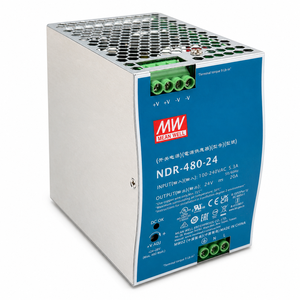
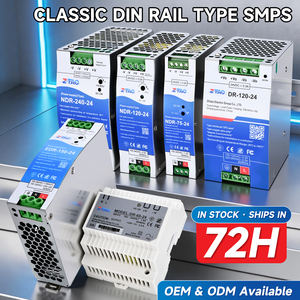
To eliminate thermal shutdown risks, our industrial DIN-rail modules (such as the NDR-480 series) and encapsulated board-mount AC-DC converters utilize ultra-high-efficiency topologies (up to 94%) paired with high-thermal-conductivity potting compounds. By reducing internal power dissipation, our modules achieve flat derating curves that allow 100% full-load output up to +50°C and reliable operation up to +70°C or +85°C with minimal airflow derating.
| Specification Parameter | Standard Industrial SMPS | Medical-Grade 2xMOPP Supply | Impact on Kuwait Hospital Deployment |
|---|---|---|---|
| Galvanic Isolation | 1,500 VAC - 3,000 VDC | 4,000 VAC (Reinforced) | Prevents electrical breakdown during utility grid surge spikes. |
| Patient Leakage Current | < 500 µA (0.5 mA) | < 10 µA (BF/CF Patient Contact) | Eliminates micro-shock hazards in surgical & ICU equipment. |
| Creepage & Clearance | 3.2mm / 2.5mm | > 8.0mm / > 5.0mm | Prevents arcing in dust-prone or high-humidity coastal environments. |
| Thermal Derating Threshold | Starts derating at +40°C | Full output to +50°C / +60°C | Ensures 24/7 continuous operation in elevated ambient temps. |
| EMC Immunity (IEC 60601-1-2) | Class A Industrial | Class B Medical (4th Edition) | Prevents electromagnetic interference with sensitive MRI/ECG devices. |
2.3 Input Voltage Transient Resiliency (3-Phase 4-Wire & Universal AC)
Kuwait operates on a 240V / 50Hz electrical distribution grid. Due to extreme seasonal variations in regional power consumption, grid lines can experience transient overvoltages, brownouts, and severe harmonic distortion caused by heavy inductive loads (large chiller plants). Our switching power supplies feature extra-wide universal input ranges (85VAC to 305VAC) and withstand surge inputs of 300VAC for 5 seconds without damage. Additionally, active Power Factor Correction (PFC > 0.95) reduces reactive power draw, ensuring full compliance with international harmonic current standards (IEC 61000-3-2 Class D).