China Wholesale Low Voltage Manufacturing: Architectural Overview & Engineering Standards
The global demand for high-reliability, low-voltage power conversion systems has undergone a structural shift. As smart factories, renewable energy grids, EV charging infrastructures, and medical diagnostic instruments grow in complexity, the underlying power supply unit (PSU) can no longer be treated as a commodity component. Modern OEM and ODM procurement teams seeking reliable China wholesale low voltage manufacturers & exporters must evaluate potential manufacturing partners through a rigorous technical lens that emphasizes galvanic isolation, thermal mitigation, electromagnetic compatibility (EMC), and energy efficiency compliance.
Information Gain Insight: Selecting a low-voltage power supply requires evaluating both electrical output parameters and system-level thermal dissipation. Operating a standard 24V DIN Rail SMPS at 80% rated load within an enclosed IP67 industrial cabinet can increase internal junction temperatures by up to 35°C. This accelerates electrolytic capacitor degradation unless compensated by high-grade 105°C-rated capacitors and active power factor correction (APFC).
1. Advanced Topology Architectures in Low Voltage Conversion
Modern low-voltage power conversion relies on distinct circuit topologies optimized for specific wattage ranges, dynamic load profiles, and form factors:
- Single-Ended Flyback Converters (0W – 150W): Preferred for lower power wall adapters and board-mount AC-DC modules due to low component counts and cost-effective isolation barriers. Utilizing primary-side regulation (PSR) eliminates the need for optocouplers, enhancing long-term MTBF in high-vibration industrial settings.
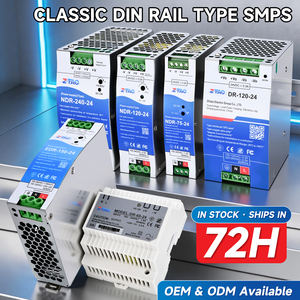
- Active Clamp Forward & Two-Switch Forward Topologies (100W – 300W): Standard across mid-range industrial DIN-rail power supplies. These topologies deliver superior transformer utilization and lower peak switching stresses on power MOSFETs, yielding conversion efficiencies up to 92%.
- LLC Resonant Half-Bridge Converters (250W – 1000W+): Crucial for high-density, low-noise applications such as medical equipment (IEC 60601-1) and high-power LED drivers. By implementing Zero Voltage Switching (ZVS) across the primary MOSFETs and Zero Current Switching (ZCS) on the secondary synchronous rectifiers, LLC converters drastically minimize switching losses and electromagnetic radiation.
2. Critical Isolation and Compliance Metrics (E-E-A-T Benchmark)
Exporting low-voltage electronics globally requires rigorous compliance with international safety standards. Leading Chinese exporters maintain full design-in validation files and international test reports (CB Scheme, UL, TÜV, CE) to streamline OEM system integration:
| Application Domain |
Safety Standard |
Isolation Voltage (AC/DC) |
Creepage / Clearance Requirements |
| Industrial Automation (PLCs, Drivers) |
IEC / EN / UL 62368-1 |
3.0 kVAC / 4.2 kVDC |
≥ 6.4 mm (Pollution Degree 2) |
| Medical Equipment (Patient Contact) |
IEC / EN / ES 60601-1 (2xMOPP) |
4.0 kVAC / 5.7 kVDC |
≥ 8.0 mm (Reinforced Insulation) |
| Railway Rolling Stock |
EN 50155 / EN 45545-2 |
1.5 kVAC / 2.1 kVDC |
Shock & Vibration Proof (Category 1B) |
| LED Lighting & Signage |
IEC / EN 61347-1, UL 8750 |
3.75 kVAC |
IP65 / IP67 Weatherproof Rating |
Future Procurement Trends in Low Voltage Power Supplies (2025–2030)
As international energy efficiency standards tighten and power densities increase, B2B procurement managers and system designers must navigate several major technology transitions when sourcing low-voltage power devices from China:
1. Widescale Adoption of Wide Bandgap Semiconductors (GaN & SiC)
Gallium Nitride (GaN) and Silicon Carbide (SiC) FETs are rapidly replacing traditional Silicon MOSFETs in premium low-voltage switching power supplies. By operating at switching frequencies exceeding 500 kHz—compared to 65–100 kHz for conventional silicon—GaN-based power converters allow engineers to shrink passive magnetic components (transformers and inductors) by up to 40%. This yields ultra-compact desktop adapters and high-density DIN-rail units boasting efficiencies above 95%.
2. Transition to Smart Digital Power Management (PMBus / CANbus Integration)
Industrial Automation 4.0 demands real-time telemetry from cabinet components. Modern low-voltage SMPS platforms now incorporate microcontrollers supporting PMBus or CANopen communication protocols. Procurement specifications increasingly require real-time reporting of output voltage, load current, internal heatsink temperature, and remaining operating lifespan estimates based on capacitor thermal stress.
3. Stringent Global Efficiency Mandates
Regulatory bodies across North America and Europe have elevated minimum efficiency and standby power consumption thresholds. Importers must ensure products meet or exceed:
- US Department of Energy (DoE) Level VI: Mandating no-load power consumption below 0.1W for external power supplies up to 49W, and minimum active-mode average efficiency threshold curves.
- EU ErP Lot 6 & CoC Tier 2: Enforcing strict off-mode and standby limits for electronic equipment integrated into industrial and residential automation networks.
Supply Chain Resilience Strategy: Partnering with established Chinese manufacturing hubs that maintain dual-sourcing agreements for critical IC controllers and high-grade magnetic cores guards against global supply disruptions, keeping OEM assembly lines fully operational.
Comparative Technical Selection Matrix for OEM Buyers
To assist technical directors and sourcing managers in selecting the ideal low-voltage architecture, the following matrix outlines key operational parameters across our core product categories:
| Power Supply Category |
Power Range |
Efficiency (Peak) |
Cooling Method |
Primary Industrial Use Case |
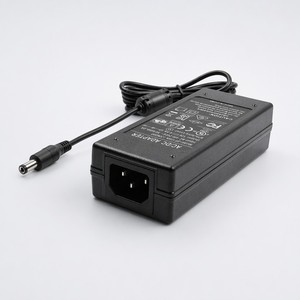
| Desktop Power Adapters |
5W – 200W |
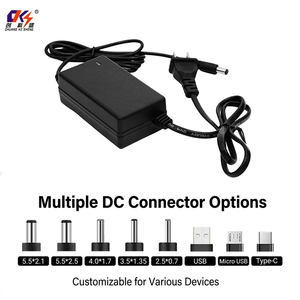
88% – 92% |
Convection (Sealed Plastic Case) |
CCTV, Medical Monitors, POS Terminals |
| Industrial DIN Rail Supplies |
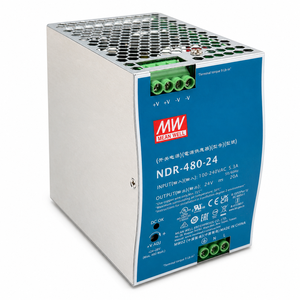
15W – 960W |
90% – 95% |
Natural Convection / Perforated Case |
PLC Cabinets, Factory Automation, Robotics |
| ATX Desktop Power Units |
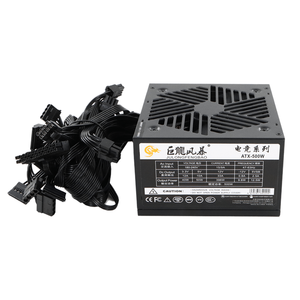
300W – 1000W |
82% – 90% (80+ Standard) |
Active Fan Cooling (120mm Intelligent) |
IPC (Industrial PCs), Edge Servers, Kiosks |
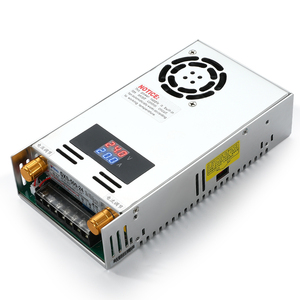
| Adjustable Laboratory SMPS |
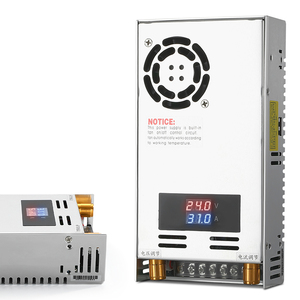
100W – 3000W |
85% – 93% |
Forced Air (Speed-Controlled Fan) |
R&D Testing, Electroplating, Battery Charging |
| Encapsulated Board-Mount Modules |
1W – 60W |
80% – 89% |
Conduction (Thermal Potting Compound) |
Smart Grid Meters, IoT Nodes, Embedded Controllers |
Frequently Asked Questions (Technical & Procurement FAQ)
Direct answers from our senior power supply engineering team regarding selection, compliance, and custom manufacturing processes.
What is the technical distinction between isolated and non-isolated DC-DC converters?
An isolated DC-DC converter uses a high-frequency transformer to galvanically separate the input and output electrical circuits. This isolation (ranging from 1.5 kVDC to 6.0 kVDC) prevents ground loops, protects sensitive microprocessors from line surges, and provides safety compliance for medical and industrial applications. A non-isolated converter (such as a point-of-load switching regulator) shares a common ground between input and output, offering higher efficiency and smaller footprints at a lower cost, but without electrical protection barriers.
How do Aimtec power supply modules achieve compliance with IEC 60601-1 3rd Edition for medical devices?
Medical-grade power modules incorporate reinforced insulation systems, low parasitic capacitance transformers, and strict circuit design to maintain Means of Patient Protection (2xMOPP). This guarantees isolation voltage up to 4,000 VAC, creepage distances over 8.0 mm, and extremely low leakage currents (typically < 10 µA), protecting vulnerable patients connected to diagnostic or therapeutic instruments.
Can a standard off-the-shelf power module be customized for specialized OEM projects?
Yes. Modifying a proven standard power platform is significantly faster and more economical than developing a custom design from scratch. Common modifications include fine-tuning output voltage ranges, applying conformal coating for high-humidity or harsh marine environments, altering pinouts/footprints, adding custom wire harnesses/connectors, and screening units for extended operating temperatures (-40°C to +85°C).
How do I select the right AC-DC power supply for a 3-phase 4-wire distribution network?
When operating on 3-phase networks (380/400/480 VAC line-to-line), the power supply must withstand wide input voltage swings and potential phase imbalance transients. You should select a high-voltage input AC-DC converter engineered to accept up to 528 VAC input continuously, equipped with high surge immunity (IEC 61000-4-5 Level 4, 4kV line-to-earth), and featuring active PFC to maintain low total harmonic distortion (THD).
What warranty protocols and long-term lifecycle support are provided for export orders?
Our standard industrial and medical series are covered by a 5-year replacement warranty. To support long-term OEM equipment lifecycles (such as railway infrastructure or medical devices that remain in service for 10–15 years), we maintain strict component lifecycle management, issuing Product Change Notifications (PCN) and Last-Time-Buy (LTB) notices at least 12 months in advance, along with drop-in replacement options.
What quality assurance measures prevent premature electrolytic capacitor failure in sealed SMPS units?
Electrolytic capacitor degradation is the primary failure mode in switching power supplies. We utilize long-life 105°C-rated Japanese aluminum electrolytic capacitors (rated for 5,000 to 10,000 hours at maximum thermal load). Furthermore, our thermal design ensures that interior ambient temperatures near critical capacitors remain below 65°C under normal rated loads, doubling operating lifetime for every 10°C drop in temperature according to Arrhenius' equation.