
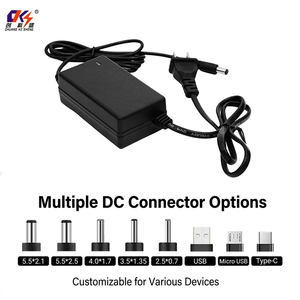
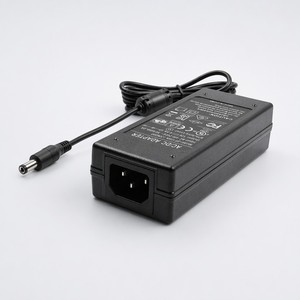
12V 2A 24W Dual Cable Desktop Power Adapter (US/EU/UK/AR)
- Universal AC Input Range
- Dual Cable CCTV Security Optimized
- Over-Current & Short-Circuit Protection
Explore our engineering-grade switching power supplies, DIN Rail converters, medical-grade modules, and industrial adapters certified for global export.
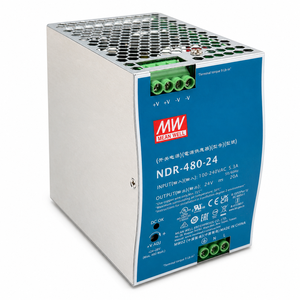
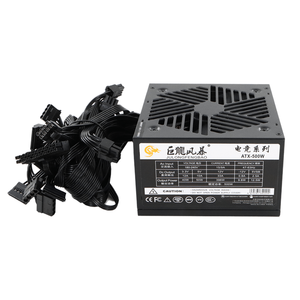
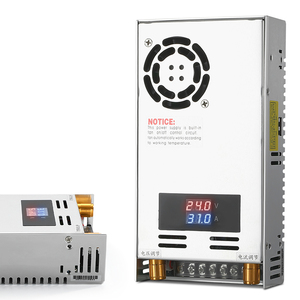
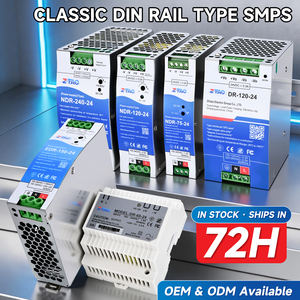
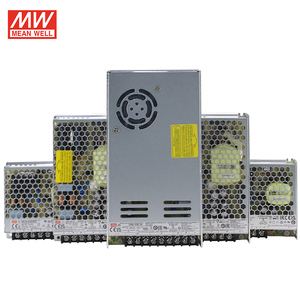
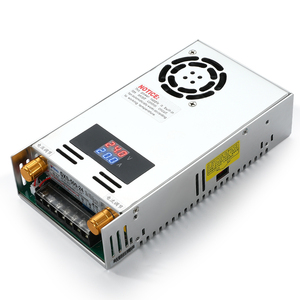
An authoritative breakdown of supply chain integration, quality assurance metrics, and technical standards driving global electronics procurement.
The global demand for reliable, high-density, and energy-efficient power conversion components has positioned China as the primary epicenter for switched-mode power supply (SMPS), AC-DC converter, and isolated DC-DC converter manufacturing. As electronic architectures across industrial automation, medical technology, electric vehicle (EV) charging infrastructure, and smart home IoT networks become increasingly sophisticated, procurement leadership requires deeper technical scrutiny than basic cost-per-watt metrics.
Modern power electronics manufacturing in China has transitioned from high-volume assembly to advanced engineering design, rigorous electromagnetic compatibility (EMC) compliance, and custom platform tailoring. Tier-1 Chinese power supply exporters maintain fully integrated manufacturing ecosystems—spanning automated surface-mount technology (SMT) lines, custom high-frequency transformer winding, automated optical inspection (AOI), and full-load burn-in testing under elevated thermal conditions.
When sourcing power conversion hardware from China, top-tier reliability is defined by complete isolation barriers (up to 6000VDC / 2xMOPP), compliance with safety standards such as IEC/EN/UL 62368-1 (Audio/VIdeo & ITE) and EN 50155 (Railway Applications), and long lifecycle commitment with guaranteed Product Change Notifications (PCN).
How our engineering platform accelerates your design-in cycle while mitigating compliance and supply chain risks.
Partnering with an established power conversion specialist provides design engineers and procurement teams with a direct competitive edge. By maintaining over 10,000 standard modular building blocks—ranging from 0.25W PCB-mount micro-converters to 1000W enclosed industrial power supplies—our manufacturing facilities eliminate the friction of long prototyping cycles.
Every platform is engineered against global safety targets including IEC/EN/UL 62368-1, IEC 60601-1 3rd Edition (2xMOPP medical insulation), EN 50155 rolling stock, and EN 45545-2 fire safety. Full CB scheme reports and UL file references are provided for seamless audit verification.
Avoid expensive ground-up redesigns. We customize output voltage trims, pinout configurations, potting compounds, conformal coatings, wire harnesses, and custom enclosures on pre-certified base platforms—reducing qualification times by up to 70%.
Our application engineers conduct complete schematic and layout reviews before PCB commit. We supply precise derating curves, thermal imaging analysis, and recommend external EMC filtering components to guarantee compliance under harsh operating environments (-40°C to +105°C).
With multi-regional logistics hubs across the Americas, Europe, and Asia-Pacific, we provide long-term product availability, product change notification (PCN) windows, and buffer stock programs to shield OEMs from component volatility.
A quick reference overview of electrical and mechanical boundaries across our core export product catalogue.
| Product Category | Input Voltage Range | Output Power / Voltage | Isolation Rating | Target Applications |
|---|---|---|---|---|
| AC-DC Converter Modules | 85 – 305 VAC (Universal Input) | 3W – 1000W / 3.3V – 48VDC | 3000 VAC – 4000 VAC | Industrial Controls, Smart Building, IoT Gateways |
| Isolated DC-DC Converters | 4.5–18V, 9–36V, 18–75V (2:1 / 4:1) | 0.25W – 600W / Dual & Single | 1500 VDC – 6000 VDC | Telecommunications, Medical, Battery Systems |
| DIN Rail Power Supplies | 85 – 264 VAC / 3-Phase 340–550 VAC | 15W – 960W / 12V, 24V, 48V | 3000 VAC (OVP/OCP/OTP) | Cabinet Automation, PLCs, Process Machinery |
| Medical Grade (2xMOPP) | 85 – 264 VAC / 80 – 160 VDC | 5W – 450W / Low Leakage (<10µA) | 4000 VAC (2xMOPP) | Patient Monitoring, Surgical Tools, Diagnostics |
| LED Driver Power Supplies | 90 – 305 VAC / Active PFC > 0.95 | 10W – 500W / Constant Current/Volt | IP65 / IP67 Weatherproof | Architectural Lighting, Streetlights, High Bay |
Strategic technology shifts shaping power electronics selection, sustainability mandates, and system architecture for the next decade.
Gallium Nitride (GaN) and Silicon Carbide (SiC) switching devices are rapidly replacing traditional silicon MOSFETs in high-density power converters. By dramatically reducing switching losses and allowing operating frequencies above several hundred kilohertz, GaN-based power supplies reduce magnetic component volume by up to 50% while achieving conversion efficiencies exceeding 96%. Procurement managers should prioritize suppliers integrating GaN topologies for space-constrained industrial and server applications.
Modern power supplies are evolving from passive components into intelligent network nodes. High-reliability industrial systems increasingly require power modules equipped with PMBus, CANbus, or I2C communication interfaces. This allows real-time monitoring of output currents, thermal status, ambient operating hours, and early degradation signals—enabling predictive maintenance protocols in critical data infrastructure and automated smart factories.
Global regulatory frameworks such as EU ErP Lot 6, DoE Level VI, and CoC Tier 2 enforce stringent efficiency standards across full and partial load curves. The market is shifting towards power converters with ultra-low no-load power consumption (<0.075W) and active power factor correction (PFC > 0.98) across wide operating ranges, ensuring compliance with evolving zero-carbon mandates.
To eliminate multiple AC-to-DC conversion stages in large-scale renewable energy storage, EV charging hubs, and industrial robotics, power distribution systems are transitioning toward high-voltage direct current (HVDC) architectures. Exporters with native support for 3-phase 4-wire input systems and wide DC input ranges (up to 1500VDC) offer critical future-proofing for industrial OEMs.
In-depth answers to critical procurement, engineering, and compliance questions faced by global buyers.
An isolated DC-DC converter uses a high-frequency internal transformer to physically and galvanically separate the input circuit from the output load. This separation prevents electrical noise, breaks ground loops, and provides high-voltage isolation (typically 1500VDC to 6000VDC), which is mandatory for medical safety and industrial sensor protection. A non-isolated converter (such as a switching regulator) shares a common ground between input and output, yielding higher efficiency and smaller footprints for localized point-of-load step-down tasks where electrical isolation is not required.
For general Information Technology Equipment (ITE), Audio/Video, and Industrial control equipment, modules must carry IEC/EN/UL 62368-1 certification (which superseded IEC 60950-1 and IEC 60065). For medical hardware, IEC 60601-1 3rd Edition with 2xMOPP (Means of Patient Protection) compliance and minimal risk leakage current (<10µA) is required. Additionally, products bound for the EU must bear CE marking (EMC Directive 2014/30/EU and Low Voltage Directive 2014/35/EU), along with RoHS and REACH environmental declarations.
When operating on 3-phase 4-wire distribution networks, line-to-neutral voltages can experience severe voltage spikes, phase imbalance, or neutral wire float conditions. You should select an AC-DC power supply rated for wide universal input (such as 340–550VAC phase-to-phase or up to 305VAC line-to-neutral) with integrated transient surge protection (IEC 61000-4-5 Level 4). Proper thermal derating and over-voltage category rating (OVC III) are crucial for direct connection to main distribution panels.
Yes. Leading manufacturers offer "Modified Standard" programs. Rather than engineering a full custom power supply—which requires high tooling costs, long NPI lead times, and fresh certification passes—manufacturers modify existing, pre-certified PCB platforms. Adjustments can include modifying output voltage rails, altering pin configurations, applying conformal coating, adding wire harnesses, or altering potted enclosures while maintaining existing safety file credentials.
Active Power Factor Correction (APFC) reshapes the input current waveform to remain in phase with the mains voltage, achieving a power factor close to 1.0 (typically >0.95). This minimizes harmonic distortion on the grid and complies with EN 61000-3-2 standards. The 80 PLUS rating indicates that the power supply achieves at least 80% efficiency at 20%, 50%, and 100% rated load, reducing wasted heat, lowering operational energy costs, and extending system component lifespan.
Electrolytic capacitors are the primary lifespan-limiting components in power supplies. According to Arrhenius' Law, every 10°C rise in operating temperature cuts capacitor life expectancy in half. High-quality manufacturers design power supplies with 105°C-rated long-life capacitors, conduct thermal stress testing, and publish detailed derating curves (e.g., derating output power by 2.5% per °C above 50°C). Evaluating a supplier's MTBF data (calculated per MIL-HDBK-217F or Telcordia standards) is vital for high-availability industrial installations.
Consult with our senior application engineers for custom power supply modifications, sample requests, schematic reviews, and factory-direct OEM pricing.
Contact Us