Explore our flagship power delivery hardware engineered for high thermal tolerance, low ripple noise, and robust surge protection.
Combining 20+ years of high-frequency power electronics design, modular flexibility, and strict compliance validation.
Every module is designed to exceed IEC/EN/UL 62368-1 targets for ITE, EN 50155 / EN 45545-2 for railway rolling stock, and 2xMOPP medical requirements per IEC/EN/ES 60601-1 3rd edition. Full CB scheme reports and UL file references are provided for design qualification files.
Shorten your time-to-market without incurring prohibitive full-custom development costs. We offer output voltage trimming, custom pinout footprints, specialized potting compounds, conformal coating, wire harnesses, and extended ambient screening (-40°C to +105°C).
Engineered for hostile electrical environments, featuring 4:1 ultra-wide DC input rails, 85–305 VAC universal AC input tolerance, and built-in protection against over-voltage, short-circuit, over-current, and thermal thermal runaway with MTBF exceeding 500,000 hours.
Supported by international regional service centers and strategic global distribution networks, we guarantee steady inventory buffers, low minimum order quantities (MOQ), and robust product lifecycle management with long-term PCN / EOL notifications.
Utilizing high-frequency LLC resonant topologies and active power factor correction (APFC), our power supplies achieve up to 94% typical efficiency at full load, minimizing thermal dissipation and saving critical space in 1U racks and outdoor enclosures.
Our dedicated power conversion engineering team performs complimentary schematic reviews, thermal budget checks, EMI pre-compliance evaluations, and layout advice prior to PCB manufacturing to ensure zero design-in bottlenecks.
In modern telecommunications, 5G wireless small cells, edge computing nodes, and enterprise networking hardware, selecting an optimal power supply unit (PSU) or switching AC/DC power module directly governs overall system reliability, energy efficiency, and operational lifespan. China's manufacturing leadership in high-density SMPS (Switched-Mode Power Supply) devices provides global engineers with unparalleled modularity, cost-efficiency, and compliance options.
Key Design Takeaway: A robust telecom power delivery network must account for input AC line transients, harmonic distortion compliance (IEC 61000-3-2 Class D), wide operating thermal derating, and high galvanic isolation (up to 4000 VAC / 6000 VDC) to prevent ground loops and equipment degradation.
The following technical reference table outlines typical parameters across major switching power supply topologies manufactured for telecom infrastructure, industrial automation, and embedded systems:
| Power Supply Architecture | Typical Wattage | Input Voltage Range | Isolation Rating | Peak Efficiency | Primary Application Target |
|---|---|---|---|---|---|
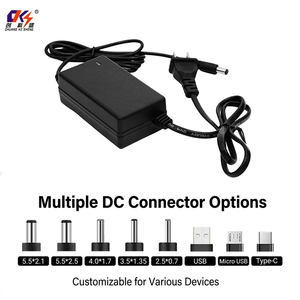
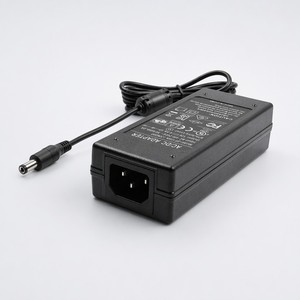
| Desktop AC/DC Switching Adapters | 5W – 200W | 90 – 264 VAC Universal | 3000 VAC Isolation | 88% - 92% | CCTV Surveillance, Router Modems, Telecom CPE |
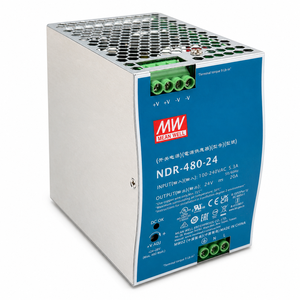
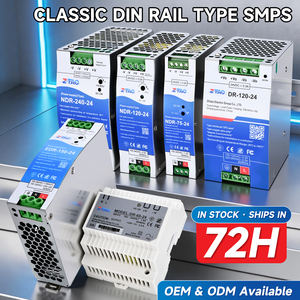
| Industrial DIN-Rail Power Supplies | 15W – 960W | 85–264 VAC / 120–370 VDC | 3000 VAC Isolation | 90% - 94.5% | PLCs, Industrial Telecom Cabinets, Automation |
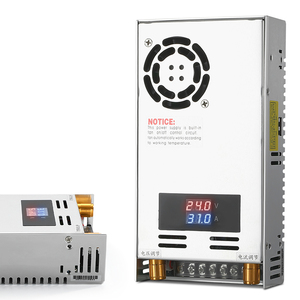
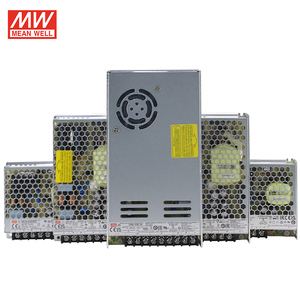
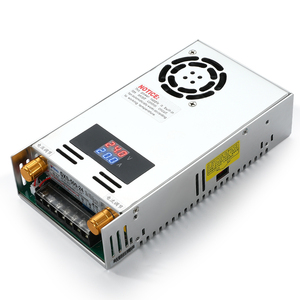
| Enclosed Chassis SMPS Units | 25W – 1000W+ | 85–305 VAC Wide Range | 3750 VAC Isolation | 89% - 93.5% | 5G Base Stations, Broadcast Systems, Heavy Machinery |
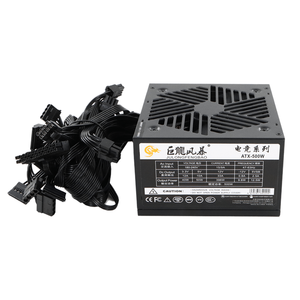
| Active PFC ATX Power Units | 400W – 1200W | 100 – 240 VAC APFC | 1500 VAC Isolation | 85% - 92% (80 Plus) | Edge Servers, Workstations, Industrial IPC |
| High-Power LED Drivers & SMPS | 50W – 800W | 100 – 277 VAC / 3-Phase | 3750 VAC (IP67 Rated) | 91% - 95% | Smart Telecom Street Poles, Outdoor Luminaires |
Telecom power supplies operating near sensitive wireless transceivers and fiber-optic switches must satisfy stringent electromagnetic compatibility (EMC) regulations, such as CISPR 32 / EN 55032 Class B radiated and conducted emission thresholds. Unmitigated high-frequency switching noise caused by parasitic inductance in transformer windings can corrupt data transmission signals or introduce bit error rate (BER) spikes in high-speed optical lines.
Leading Chinese telecom power manufacturers integrate multi-stage differential and common-mode EMI filtering circuits directly onto the primary AC input stage. Furthermore, by employing Soft-Switching topologies (LLC Resonant Converters and Zero Voltage Switching - ZVS), switching losses and high-frequency dv/dt noise spikes are drastically reduced, ensuring pristine low-noise DC output outputs (< 50 mVp-p ripple voltage).
In unconditioned outdoor cabinet deployments, internal ambient temperatures can fluctuate from frozen sub-zero winters (-40°C) to scorching summer peaks exceeding +70°C. Standard commercial-grade capacitors quickly dry out under continuous high heat, drastically shortening power supply MTBF (Mean Time Between Failures).
To overcome harsh thermal conditions, premier manufacturers employ Japanese 105°C-rated long-life electrolytic capacitors, aluminum substrate PCBs, high thermal conductivity silicone potting compounds, and intelligent fan-speed control algorithms. Derating curves are precisely calculated so that power supplies maintain full continuous output power up to +50°C or +60°C ambient, with linear derating extending up to +70°C or +85°C.
Key technological shifts and sourcing methodologies shaping the future of industrial power conversion.
Gallium Nitride (GaN) and Silicon Carbide (SiC) Wide Bandgap (WBG) switches are replacing conventional silicon MOSFETs. This allows switching frequencies to push beyond 500 kHz, shrinking transformer volume by over 40% while raising energy conversion efficiency above 96%.
Modern telecom infrastructure demands real-time telemetry. Next-generation power supplies feature integrated microcontrollers supporting PMBus 1.3 or CANbus protocols, empowering network engineers to monitor output current, voltage, temperature, and predict component failure remotely.
Global procurement managers are consolidating vendor lists toward suppliers offering modular platform platforms. Reusing standardized mechanical enclosures and footprint pinouts across multiple voltage ratings reduces qualification overhead and mitigates supply chain disruptions.
Expert answers to critical technical questions encountered during specification, testing, and OEM procurement.