Medical Grade Power Supplies are more than compact boxes that convert mains electricity into stable output. They support equipment used beside patients, clinicians, and sensitive diagnostic systems. A failure may appear small: a flickering monitor, a delayed alarm, or a stalled infusion controller. The consequences can be serious. This is why designers examine isolation, leakage current, electromagnetic compatibility, thermal behavior, and fault protection together.
Patient-safety expert James Reason wrote, “We cannot change the human condition, but we can change the conditions under which humans work.” His principle applies directly to Medical Grade Power Supplies. A dependable supply creates safer conditions by limiting electrical hazards and reducing avoidable equipment interruptions. It also helps manufacturers meet demanding medical-device requirements, including those associated with IEC 60601-1. Compliance, however, should not be treated as a magic shield. Testing cannot replace careful system design.
This article explores what makes a power supply medical grade, from reinforced insulation to controlled touch current. It considers hospital beds, imaging rooms, laboratory instruments, and portable devices. Each application creates different pressure points. A supply that performs well in a quiet laboratory may behave differently near electrosurgical equipment. That detail is easy to overlook.
There is no perfect component.
Readers should also question attractive specifications. High efficiency does not automatically mean low risk. Small size can increase heat density. Strong isolation may affect cost and performance. Understanding these compromises helps engineers, purchasing teams, and healthcare manufacturers select Medical Grade Power Supplies with greater confidence, evidence, and practical judgment.
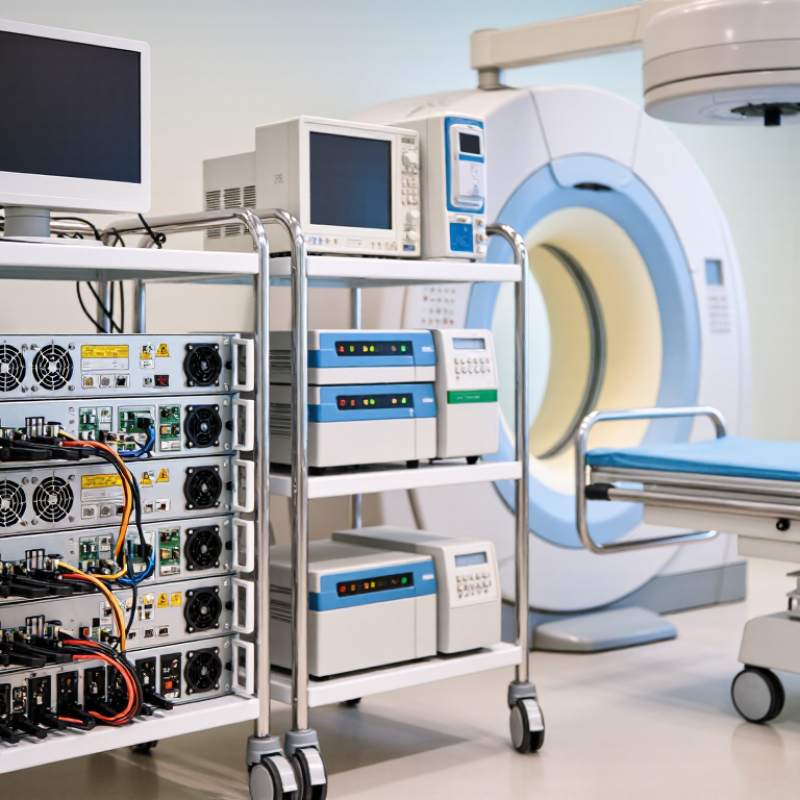
What Are Medical Grade Power Supplies?
What Defines a Medical Grade Power Supply?
A medical grade power supply is defined by controlled risk, not a reassuring label. IEC 60601-1 requires suitable insulation, protective earth, and patient protection measures. For many applications, this means two Means of Patient Protection, or 2 MOPP. The standard also limits leakage current, which matters when power reaches equipment near a patient’s body.
Safety is only one layer. IEC 60601-1-2 addresses electromagnetic compatibility, including emissions and immunity. A supply should not disturb monitoring signals, even beside infusion equipment or surgical electronics. Designers also review creepage distances, clearance, dielectric strength, overload behavior, and temperature rise. These details become visible on a test bench.
The numbers matter.
A 2024 medical device industry report from MarketsandMarkets projected continued growth in connected and portable clinical equipment, increasing demand for compact, efficient power systems. Yet market growth does not prove safety. A smaller adapter may run cooler, but it can still fail during a voltage surge or repeated start-up cycles. Practical verification should include abnormal operation and conducted emissions testing. This is where product claims sometimes feel incomplete. “Medical grade” is not a universal approval category. Certification records, test reports, risk analysis, and traceable production controls provide stronger evidence than packaging language.
What Are Medical Grade Power Supplies?
Medical grade power supplies convert mains electricity into controlled power for equipment such as monitors, imaging systems, and surgical devices. Their design is governed mainly by IEC 60601-1, which addresses electrical safety, insulation, leakage current, and protection against electric shock. Many systems also require IEC 60601-1-2 testing for electromagnetic compatibility. A supply may operate correctly in a laboratory yet fail near electrosurgical equipment or wireless transmitters. That gap matters.
Safety margins are practical, not decorative. Designers often specify two means of patient protection, reinforced insulation, and controlled touch current. IEC 60601-1 testing also examines abnormal conditions, including overloads and single faults. The World Health Organization’s Global Patient Safety Action Plan states that about one in ten patients experiences harm in healthcare. Power faults are not the only cause, but unstable voltage, overheating, or leakage can increase clinical risk. Small details become serious beside a patient.
Regulatory approval depends on the market and device classification. Manufacturers may need technical files, risk analysis under ISO 14971, EMC evidence, production controls, and traceable test records. Authorities may also review component changes after approval. That is where projects sometimes become less tidy. A supply can pass certification, but poor airflow, aging capacitors, or an unsuitable cable may weaken field performance. Engineers should test the complete device, not only the power module, under realistic load, temperature, and cleaning conditions.
Medical grade power supplies convert incoming electricity into stable, controlled power for clinical equipment. Their design must protect patients, operators, and sensitive electronic circuits. Unlike ordinary adapters, they address leakage current, insulation strength, electromagnetic interference, and fault conditions.
Electrical isolation is a central feature. Reinforced insulation separates the input from the output, reducing the risk of hazardous voltage reaching accessible parts. Designers also consider creepage and clearance distances across the circuit board. These distances may look minor, yet dust, humidity, and manufacturing variation can affect real-world safety. That gap matters.
Protection circuits respond to overloads, short circuits, and abnormal temperatures. Current limiting can prevent a damaged cable from drawing excessive energy. Thermal safeguards can shut down the supply before heat damages nearby components. Controlled inrush current also reduces stress when equipment starts, especially with motors, pumps, or large capacitors. Small details matter.
Reliable designs are evaluated against medical electrical safety requirements, including appropriate means of operator and patient protection. Testing should cover normal operation, single faults, grounding, leakage current, and dielectric strength. In practical equipment reviews, a clean output waveform is important, but it is not enough. A supply can perform well on a bench and still fail when cables move, ventilation is restricted, or several devices share a circuit. Engineers must examine the complete system, not only the power module. This remains an area where assumptions deserve careful review.
Medical-grade power supplies convert unstable mains electricity into controlled energy for patient monitors, infusion pumps, ventilators, imaging systems, and surgical equipment. Their design must address isolation, leakage current, temperature rise, and electromagnetic interference. IEC 60601-1 defines essential safety requirements, including protection against electric shock through patient and operator contact. A small failure can freeze a monitor screen or interrupt an infusion. That is not a minor inconvenience.
Home-care devices create another demanding application. The World Health Organization’s Global Report on Assistive Technology estimates that more than 2.5 billion people need at least one assistive product. Portable oxygen concentrators, sleep-therapy devices, and mobility equipment therefore need compact, quiet, and reliable power conversion. Backup operation also matters when household electricity becomes unstable. Designers often combine medical-grade supplies with batteries, alarms, and redundant circuits.
Hospitals use these supplies in crowded electrical environments. Imaging rooms, intensive-care units, and operating theatres contain many switching systems near sensitive sensors. A 2024 industry analysis from MarketsandMarkets projects continued growth in the medical power supply market, driven by connected monitoring and home healthcare. However, market growth does not guarantee safety. Engineers still need documented testing, risk analysis, and traceable production controls. Certification alone may not reveal every field problem. Condensation, loose connectors, and poor maintenance remain practical weaknesses.
Medical grade power supplies are designed for equipment used near patients and clinical staff. They control electrical leakage, insulation failure, electromagnetic interference, and abnormal operating conditions. Many designs are evaluated against standards such as IEC 60601-1 and IEC 60601-1-2. However, a medical label alone does not prove suitability. The complete power system, enclosure, cables, and final device still require assessment.
Start with the device’s voltage, current, power, and startup requirements. Check whether the supply supports continuous operation, peak loads, and safe shutdown behavior. Review means of operator protection and means of patient protection, including required insulation levels and leakage-current limits. For equipment connected directly to patients, isolation requirements deserve special attention. Confirm the input range, output regulation, cooling method, noise level, and expected service life. A compact supply may fit the enclosure, but poor airflow can cause heat buildup and early failure. That detail is easy to miss.
Tips: Request current test reports, not only marketing claims. Verify the exact model and configuration. Test the supply with the real load, cables, and enclosure. Measure temperature during worst-case operation. Consider cleaning chemicals, humidity, vibration, and repeated power cycling. Also check documentation for creepage, clearance, fuses, and protective earth. I would not approve a supply from a datasheet alone. Real equipment can behave differently, and one overlooked cable may change the safety result.
It converts mains electricity into controlled power for medical equipment. A stable output protects monitors, pumps, and imaging systems.
IEC 60601-1 addresses insulation, leakage current, electric shock, and abnormal operating conditions. IEC 60601-1-2 covers electromagnetic compatibility testing.
Hospitals contain wireless transmitters, switching systems, and electrosurgical equipment. Interference may freeze a screen or distort sensor readings.
Designs may use reinforced insulation and two means of patient protection. They also control touch current and test single-fault conditions.
They support patient monitors, infusion pumps, ventilators, imaging systems, and surgical equipment. Home-care devices use them too.
Portable devices need compact, quiet, and reliable power conversion. Battery backup can help during unstable household electricity. Space is limited.
They may need risk analysis, technical files, EMC evidence, and traceable test records. Testing should include realistic loads, temperatures, cleaning conditions, and complete devices.
No. Certification is not perfection. Poor airflow, aging capacitors, loose connectors, or unsuitable cables can still cause problems.
They should check ventilation openings, connector tightness, cable condition, and condensation. Small details matter near patients. Maintenance is easy to underestimate.
Medical Grade Power Supplies are specially designed to deliver stable, reliable, and safe power for equipment used in healthcare environments. Unlike standard power supplies, they must meet strict safety and regulatory requirements related to electrical isolation, leakage current, electromagnetic compatibility, insulation, and protection against overvoltage, overload, and short circuits. Their design helps reduce risks to both patients and medical personnel while supporting consistent equipment performance.
These power supplies are commonly used in diagnostic systems, patient monitoring devices, laboratory instruments, therapeutic equipment, and other healthcare technologies. Selecting the right model requires careful consideration of output voltage and current, power capacity, efficiency, cooling method, operating conditions, isolation level, connector type, and applicable certifications. Designers should also evaluate reliability, service life, size, and compatibility with the final medical device. A suitable power supply should meet the equipment’s technical demands while providing dependable protection throughout daily operation.