Choosing the right LED Driver Power Supplies can determine whether a lighting project performs reliably or becomes a costly maintenance problem. Global buyers often compare wattage first, yet wattage alone rarely tells the complete story. Output voltage, constant-current accuracy, efficiency, thermal protection, dimming compatibility, and enclosure quality matter just as much.
This guide examines ten practical types used across commercial, industrial, residential, and outdoor applications. It considers constant-voltage drivers for strip lighting, constant-current models for high-power fixtures, waterproof units for landscape projects, and compact drivers for space-limited installations. Each type has a different operating purpose. A driver designed for a dry indoor ceiling should not automatically serve a wet exterior sign. Small details matter, such as a driver’s heat dissipation near a crowded junction box or its behavior when the input voltage fluctuates.
Real purchasing decisions also involve certification records, supplier experience, warranty terms, replacement availability, and technical support. These factors can be more valuable than a low initial price. However, product labels are not always perfectly transparent. Some efficiency claims depend on load conditions, while advertised lifespans may assume ideal temperatures. That deserves careful review.
No single driver fits every project. Buyers should match the power supply to the LED load, installation environment, control system, and regional requirements. Testing a sample under realistic conditions is wise. It may reveal noise, heat, flicker, or wiring issues before a large order is placed. The following overview offers a practical foundation for comparing LED Driver Power Supplies with greater confidence and fewer assumptions.
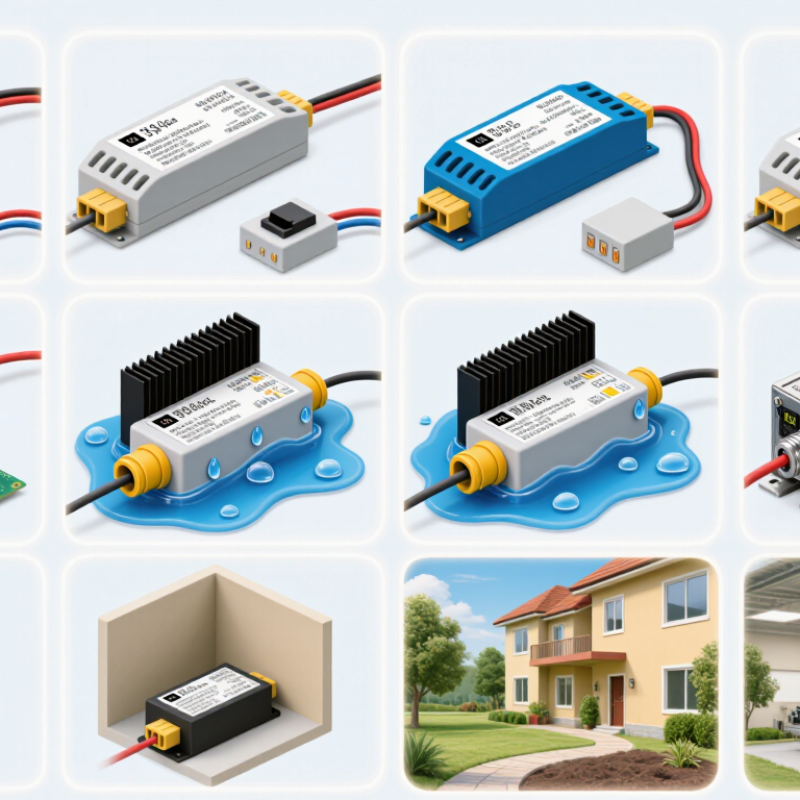
LED driver power supplies regulate electrical energy for LED modules, strips, and luminaires. Unlike ordinary power adapters, they usually control constant current or constant voltage. This prevents unstable brightness, premature LED aging, and dangerous thermal stress. Their role becomes critical when input voltage, ambient temperature, and load conditions change across global installations.
A typical driver includes an input rectifier, switching controller, power transistor, transformer or inductor, and output rectifier. Feedback circuits monitor voltage or current continuously. Protection features may include short-circuit, overvoltage, overcurrent, and thermal shutdown functions. The enclosure also matters. It must support insulation, ventilation, and suitable ingress protection for the installation environment.
In practical sourcing, buyers should check output tolerance, efficiency, power factor, dimming compatibility, and operating temperature. Heat matters. A driver rated at 100 watts may need derating inside a sealed fixture. Testing at full load for several hours can reveal excessive ripple or rising case temperature. Datasheets are useful, but field conditions are less tidy. Cable length, poor ventilation, and voltage fluctuation can change performance. I have found that many selection errors begin with wattage alone. A safer evaluation compares the driver with the LED load, enclosure, control method, and local electrical requirements. Reliability is built through measured margins, not optimistic assumptions.
It regulates electrical energy for LED modules, strips, and luminaires. A stable driver helps prevent flicker, aging, and excessive heat.
Constant-current drivers maintain a set current for compatible LED modules. Constant-voltage drivers maintain a fixed voltage, often for suitable LED strips. The wrong type can cause failure.
Common parts include a rectifier, switching controller, power transistor, transformer, and output rectifier. Feedback circuits monitor current or voltage continuously. Protection circuits may shut the driver down during faults.
Match the driver’s output voltage or current with the LED load. Also check dimming method, wiring polarity, input range, and output tolerance. Small mismatches may create visible flicker.
Heat can shorten driver life and stress connected LEDs. A 100-watt driver may need reduced loading inside a sealed fixture. Ventilation matters. Measure the case temperature during operation.
Look for short-circuit, overvoltage, overcurrent, and thermal shutdown protection. The enclosure should provide suitable insulation and ventilation. Its environmental protection should match the installation location.
Check efficiency, power factor, harmonic distortion, surge protection, and output stability. These details affect energy use and system reliability. Wattage alone is not enough.
Not always. Datasheets provide useful ratings, but real installations include long cables, heat, and voltage changes. Test samples at full load for several hours. Look for rising temperature or excessive output ripple.
Temperature, enclosure design, ventilation, and load level strongly influence service life. Published lifetimes may assume favorable conditions. Field performance can be different. That possibility deserves honest consideration.
LED Driver Power Supplies are essential components that regulate electrical energy and convert it into the stable output required by LED lighting systems. This overview introduces their definition, role, and core components, while explaining the differences between constant-current and constant-voltage designs. It also examines how indoor, outdoor, and weatherproof constructions are developed to meet different installation and environmental requirements.
For modern lighting projects, buyers can choose from dimmable, smart, and programmable LED driver solutions to support adjustable brightness, automation, and efficient control. The article also highlights the key factors global buyers should compare, including electrical compatibility, output performance, thermal management, protection features, installation conditions, and applicable safety requirements. Understanding these differences helps purchasers select reliable LED power supplies that match the lighting load, operating environment, control system, and local regulations.