DIN Rail AC-DC Converters are becoming a critical link between facility power and compact industrial electronics. In 2026, buyers will likely compare more than output voltage and price. They will examine efficiency, thermal behavior, redundancy, communication, and installation space. A converter mounted beside a PLC may face heat, vibration, dust, and unstable loads every day. Small differences can affect uptime.
Industry research supports this broader view. MarketsandMarkets’ Industrial Power Supply Market reports identify factory automation, renewable energy, and smart infrastructure as major demand drivers. Grand View Research also highlights rising investment in industrial automation and distributed control equipment. These trends support stronger demand for compact, efficient, and digitally monitored power supplies. However, market forecasts do not guarantee one universal winner. Cabinet temperature and load patterns still matter.
The leading 2026 types may include single-phase compact units, three-phase high-power converters, ultra-slim models, redundant power systems, and intelligent units with DC-OK contacts or network monitoring. Battery-backed and energy-storage applications may also increase interest in specialized DC power architectures. Safety and electromagnetic compatibility remain essential. Designers should verify relevant IEC and EN requirements, including IEC 61000-6-2 for industrial immunity and applicable equipment safety standards.
Efficiency matters. So does recovery after a short circuit. A crowded control cabinet exposes weak thermal designs quickly. This article compares the most practical DIN Rail AC-DC Converters for 2026, while recognizing an uncomfortable point: the “top” type depends on the application, not the marketing label.
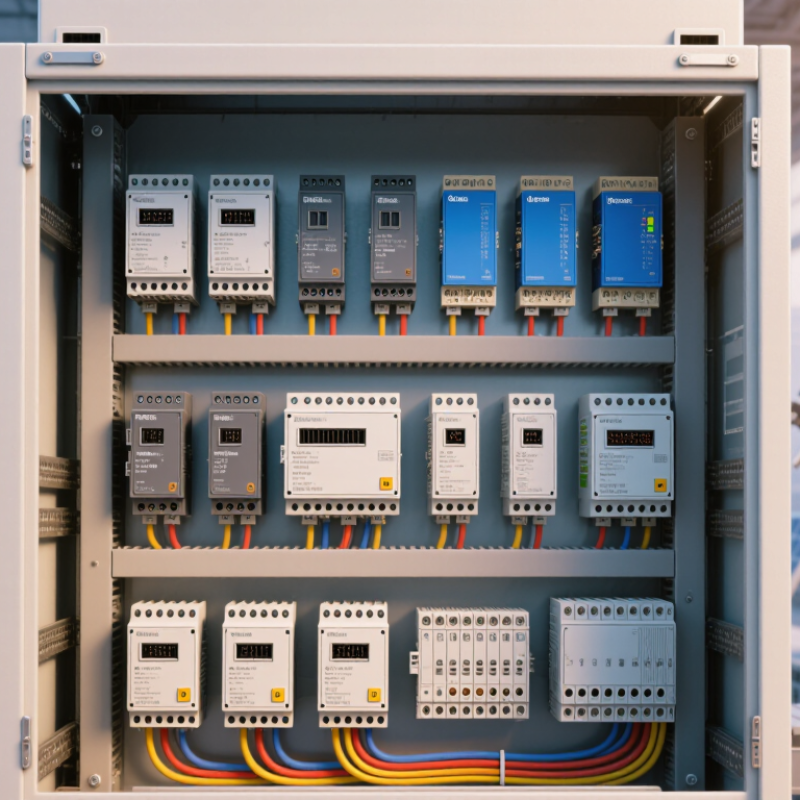
What Are the 2026 Top DIN Rail AC DC Converter Types?
DIN rail AC-DC converters are increasingly judged by safety class, efficiency, and installation flexibility. Under IEC 61558, switched-mode power supply units should address insulation, thermal stress, abnormal operation, and transformer safety. Isolated converters remain the preferred choice for control cabinets because they separate hazardous input voltage from low-voltage circuits. SELV and PELV outputs are common where sensors, PLCs, and actuators need safer touch conditions.
Compact single-phase models suit small panels and distributed control boxes. Higher-power units may use two-phase or three-phase input designs to reduce current on each line. Redundant converters support critical automation loads, although their extra wiring increases inspection time. Wide-input converters also help plants with unstable supply networks. Check the datasheet carefully. “Universal input” does not replace correct overvoltage protection.
For 2026 designs, efficiency targets will emphasize lower standby losses, better light-load performance, and reduced cabinet heat. A converter operating above 90 percent at its rated load may still waste energy during nighttime idling. Measure actual load behavior. A 120-watt unit powering 18 watts can become an inefficient choice. Engineers should verify ambient derating, short-circuit response, leakage current, and the exact IEC 61558 part used. Installation experience shows a small weakness: efficiency figures are often tested under ideal conditions, while dusty cabinets and crowded rails behave differently. Leave ventilation space. Then confirm regional ecodesign and electrical safety requirements before approval.
| Converter Type | Typical Power Range | Common Output | Isolation and IEC 61558 Relevance | Typical Efficiency Range* | Practical 2026 Design Target* | Typical DIN Rail Applications |
|---|---|---|---|---|---|---|
| Linear Regulated AC-DC Supply | 5–100 VA | 5 V, 12 V, or 24 V DC | Usually uses a mains-frequency transformer, rectifier, and linear regulator. Safety assessment may involve the applicable IEC 61558 transformer part and IEC 61558-1 general requirements. | 30–60% | Generally not preferred for new 2026 designs; use only where very low noise or simple regulation is essential. | Low-noise control circuits, legacy instrumentation, and small auxiliary loads. |
| Flyback Switching Converter | 5–150 W | 5–48 V DC | Galvanically isolated versions commonly use a high-frequency transformer. IEC 61558-2-16 is the relevant particular standard for switch-mode power supply units and their transformers. | 75–90% | At least 88–92% at rated load, with standby power minimized and thermal rise controlled. | Compact sensors, building controls, access systems, and low-power PLC accessories. |
| Two-Switch Forward Converter | 100–600 W | 12 V, 24 V, or 48 V DC | Isolated topology with a high-frequency transformer; construction, insulation, creepage, clearance, and dielectric testing are evaluated under the applicable IEC 61558 requirements. | 85–94% | At least 92–95% at rated load, with stable regulation across the declared input range. | Industrial automation, distributed I/O, machine controls, and medium-power control cabinets. |
| Half-Bridge or LLC Resonant Converter | 300–1,000 W | 24 V or 48 V DC | Isolated high-frequency architecture. IEC 61558-2-16 is typically the key product-safety reference when the unit falls within its scope. | 90–96% | At least 94–96% at rated load; achieve good light-load performance through burst, skip, or advanced control modes where appropriate. | High-density automation panels, robotics, telecom control power, and demanding 24 V systems. |
| Three-Phase Diode-Bridge Switching Supply | 480 W–3 kW | 24 V, 48 V, or 96 V DC | Uses a three-phase input rectifier followed by an isolated or non-isolated DC-DC stage. The insulation system and transformer portion must be assessed against the applicable IEC 61558 requirements. | 90–96% | At least 94–97% at rated load, with input-current distortion and inrush managed for the installation. | Large control cabinets, conveyor systems, process equipment, and factory automation. |
| Power-Factor-Corrected AC-DC Supply | 500 W–3 kW | 24 V, 48 V, or 110 V DC | Adds an active PFC stage before the isolated DC-DC converter. IEC 61558-2-16 addresses the switch-mode supply safety aspects; EMC and harmonic-current requirements are assessed separately under applicable product and installation standards. | 92–97% | At least 95–97% at rated load, with power factor typically above 0.95 at substantial load where the design requires PFC. | High-power DIN rail systems, industrial networking, motion-control auxiliaries, and energy-sensitive installations. |
| Redundant or Hot-Swap DIN Rail Power System | 120 W–2 kW per module | 24 V or 48 V DC | Normally built from isolated switch-mode modules with ORing, current sharing, and fault-isolation circuitry. Each power module is assessed according to its applicable safety standard; IEC 61558-2-16 may apply to the switch-mode supply section. | 88–95% | At least 93–96% per active module while maintaining seamless transfer, low reverse current, and predictable fault behavior. | Safety-related controls, process automation, data acquisition, and systems requiring high availability. |
| Three-Phase Active-Front-End Converter | 1–10 kW | 24–400 V DC | Uses controlled semiconductor switching for rectification and power-factor correction, followed by an isolated or non-isolated output stage. IEC 61558 applicability depends on the transformer or power-supply construction and declared product scope. | 94–98% | At least 96–98% at rated load, with controlled harmonics, regenerative capability where required, and validated thermal performance. | Large automation systems, battery interfaces, energy storage auxiliaries, and high-power industrial DC buses. |
Common types include isolated single-phase, three-phase, wide-input, and redundant converters. They support different loads, panel sizes, and continuity needs. Keep the design practical.
Isolation separates hazardous input voltage from low-voltage circuits. This supports safer sensor, PLC, and actuator connections. SELV and PELV outputs are common choices.
It suits sensors, relays, small PLCs, and compact operator interfaces. At 24 VDC, 120 W provides about 5 A. Reserve 20% to 30% capacity for aging and expansion.
No. Motors, solenoid valves, and communication devices may create startup demands. Check actual load behavior, overload recovery, ripple, and voltage stability. Nameplates can mislead.
Three-phase units suit demanding panels requiring about 480 to 960 W. They can reduce current stress across the supply network. They also support heavy machinery startup more effectively.
Leave clear space around ventilation openings and terminals. Crowded or dusty cabinets can run hotter than laboratory tests. Keep airflow open.
Not always. A converter above 90% efficiency at rated load may waste more energy at night. For example, a 120 W unit powering 18 W may be poorly matched. Measure real operating patterns.
Review short-circuit response, overtemperature protection, input surge protection, and leakage current. Confirm ambient derating and the exact applicable standard requirements. Read the manual carefully.
Redundancy can support critical automation loads during a converter fault. However, it adds wiring, inspection time, and maintenance work. More hardware is not automatically better.
Choosing a converter with barely enough reserve can increase enclosure temperature. I once made that choice, and it worked, but it was not ideal. Allow space for terminals, inspection, and future replacement.
In 2026, DIN Rail AC-DC Converters are expected to remain essential for reliable power distribution in automation and industrial control panels. Their main classes include standard 24 VDC single-phase models, typically designed for automation loads up to around 120 W, as well as three-phase high-power supplies ranging from approximately 480 to 960 W. Selection depends on panel capacity, load profile, input configuration, thermal conditions, and targeted efficiency levels under IEC 61558-related requirements.
For applications requiring uninterrupted operation, redundant and UPS-ready units support N+1 configurations and continuous 24 VDC availability during supply or module faults. Wide-input models are suitable for IIoT panels exposed to varying voltage conditions, while Class 2 versions help address controlled power limits and wiring needs in appropriate installations. Across all categories, engineers should also evaluate EMC performance, overload protection, cooling, space utilization, and compatibility with applicable NEC limits when designing efficient and dependable 2026 control systems.